
Siapa Nama Kamu? Exhibition Catalogue
Table of content:
- Foreword
- Introductory
- Chapters Overview
- Tropical Tapestry
- Nanyang Reverie
-
The Real against the New: Social Realism and Abstraction
- Real Concerns: Social Realism as an Artistic Practice
- Realism: History Painting from Below
- Portraiture: Portraying the People
- Imprints of Everyday Life: The Woodcut Movement
- Realism across the Boundaries of Medium
- New Language: Different Paths to Modernity
- The Great Debate: The Real and the New
- Conclusion: Different Modes of Representing the Real and the New
- Tradition Unfettered: The Story of Singapore Ink
- Shifting Grounds
- Image Plates
- Glossary
Footnotes
- It is worth mentioning Kwok Kian Chow, Channels and Confluences: A History of Singapore Art (Singapore: Singapore Art Museum, 1996). Channels and Confluences was published on the occasion of the opening of the Singapore Art Museum, and has been instrumental as an introductory text for scholars and students seeking a survey of Singapore art. Another text that has received lesser attention is Past, Present, Beyond: Re-nascence of an Art Collection, edited by T.K. Sabapathy (Singapore: NUS Museums, 2002). It contains essays by Gauri Parimoo Krishnan, Constance Sheares, Roxana M. Brown and T.K. Sabapathy on aspects of the National University of Singapore’s collection that range from classical Indian sculptures to Chinese and Southeast Asian ceramics to textiles and modern Southeast Asian art. The volume is significant not only because it highlights the many facets of an early institutional art collection in Singapore, but the manner in which art historical scholarship in Southeast Asia and Singapore is heavily mediated through what we differentiate today as “ethnographic” and “modern art” objects. The National University of Singapore Museum continues to negotiate this tension in its exhibitionary work to the present day. This is somewhat in contrast to the history of the national collection held by the National Heritage Board that has since the 1990s developed “specialised” museums such as the National Museum of Singapore, Asian Civilisations Museums, and even the National Gallery Singapore and Singapore Art Museum. These museums trace their origins to the Raffles Museum and Library as the primary source from which their collections were drawn. The Raffles Museum was an encyclopaedic museum, set up by the British in the 19th century, and operated within a much larger remit of advancing colonial science through the accumulation of ethnographic objects and natural history specimens. The natural history collection is now overseen by the Lee Kong Chian Natural History Museum (established in 2014, and formerly the Raffles Museum of Biodiversity Research) at the National University of Singapore. For more details, see Gretchen Liu, One Hundred Years of the National Museum: Singapore 1887–1987 (Singapore: The Museum, 1987); Asian Civilisations Museum, Hunters & Collectors: The Origins of the Southeast Asian Collection at the Asian Civilisations Museum, exh. cat. (Singapore: Asian Civilisations Museum, 2009); Kevin Y.L. Tan, “The National Museum as Maker and Keeper of Singapore History,” in The Makers and Keepers of Singapore History, eds. Loh Kah Seng & Liew Kai Khiun (Singapore: Ethos Books, 2010), 122–36.
- John Clark, Modern Asian Art (Sydney: Craftsman House, 1998), 49–54
- While this essay focuses on the emergence of the "modern" in Singapore art, it is acknowledged that there were pre-existing pictorial traditions in the Malay Archipelago, such as sculptures, illuminated manuscripts and textiles.
- For existing scholarship on the story of art-making and visual practices in Singapore from the 19th century through to the development of Nanyang art in the 1950s, overviews of different eras include Wong Hong Suen, Singapore through 19th-Century Prints & Paintings (Singapore: National Museum of Singapore, 2010); Yeo Mang Thong, Xinjiapo zhanqian huaren meishushi lunji [Essays on the History of Pre-War Chinese Art in Singapore] (Singapore: Singapore Society of Asian Studies, 1992); Redza Piyadasa and T.K. Sabapathy, Pameran Retrospektif Pelukis-Pelukis Nanyang (Kuala Lumpur: Muzium Seni Negara Malaysia, 1979); Kwok Kian Chow, Channels and Confluences: A History of Singapore Art (Singapore: Singapore Art Museum, 1996).
Introductory Remarks
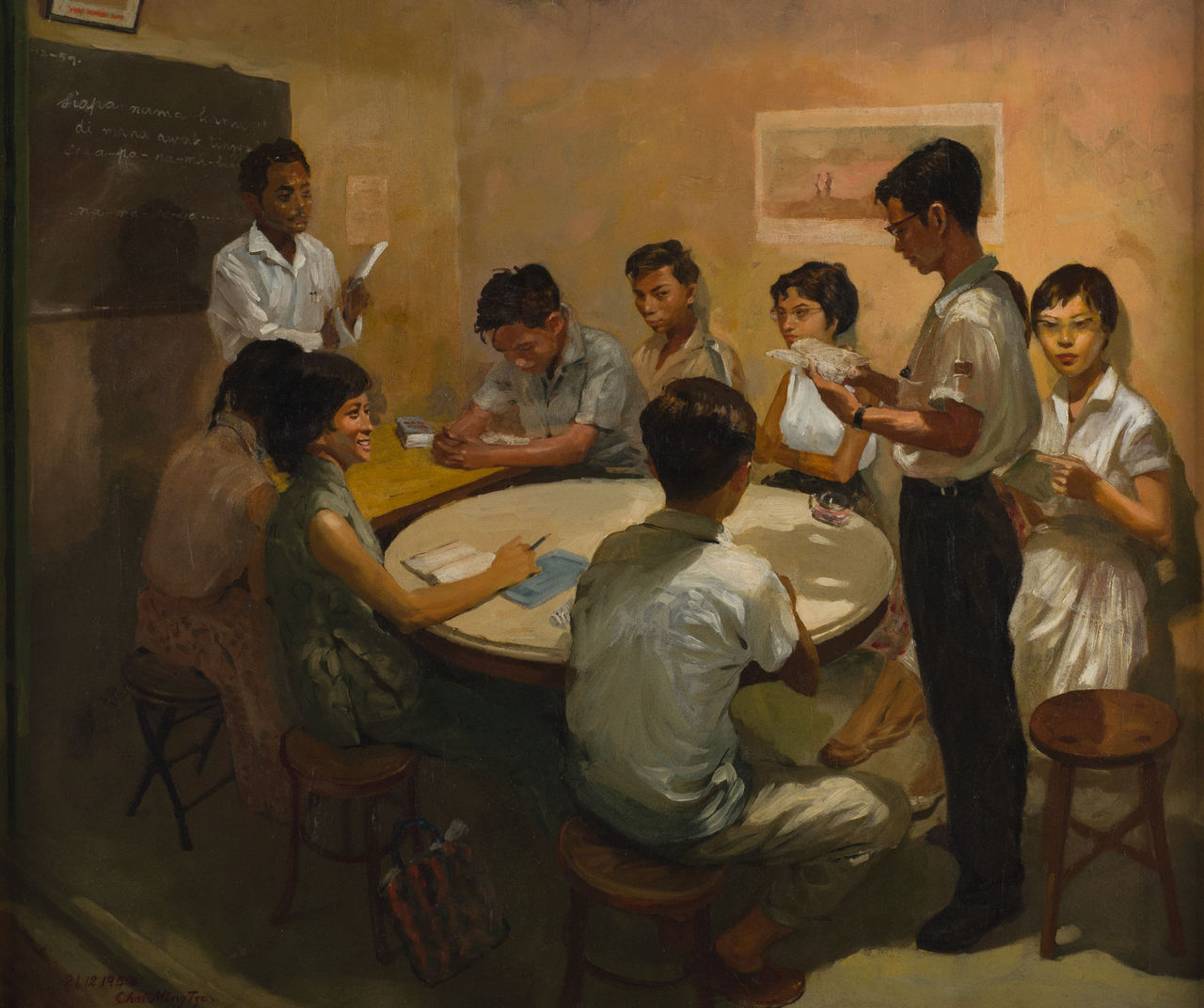
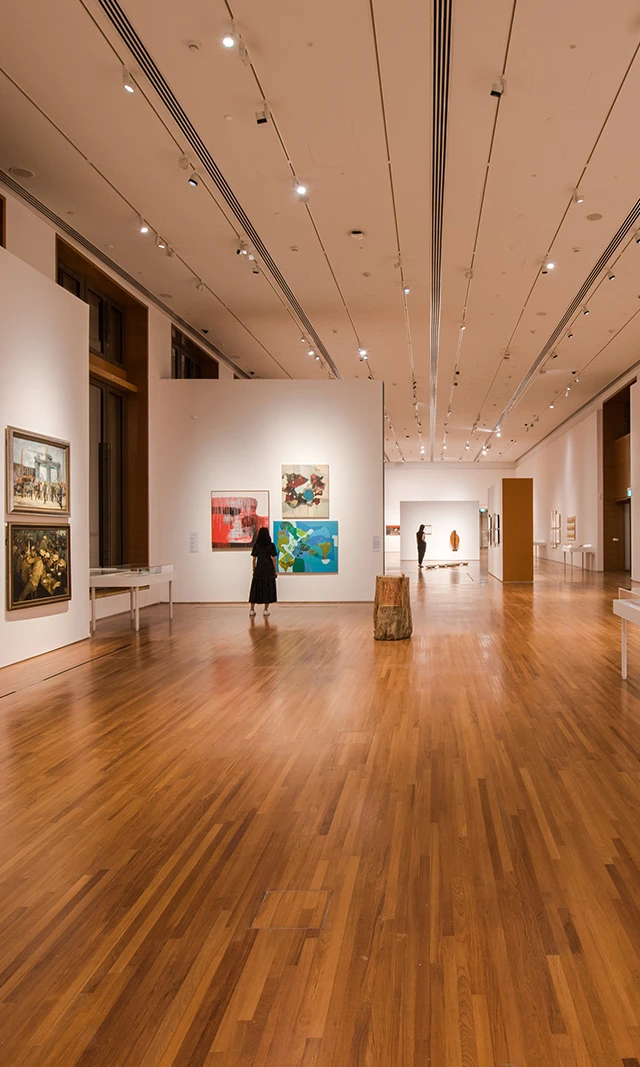
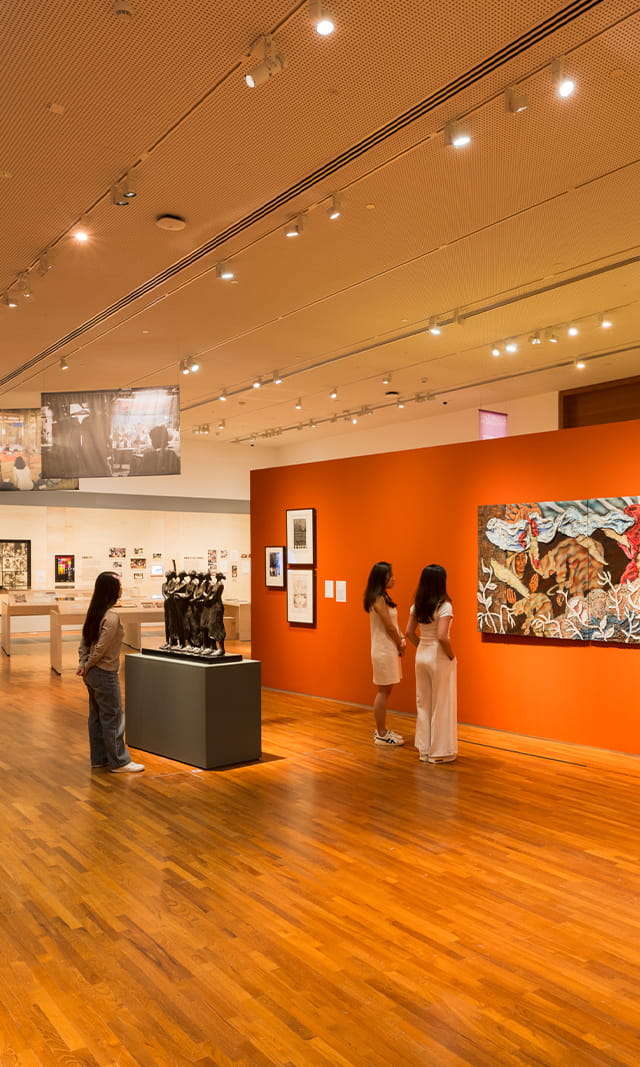
The inaugural long-term display for the DBS Singapore Gallery emerged through extensive discussions with art historians, artists, critics and curators on how “modernism” in Singapore should be understood and presented. These conversations questioned definitions, historical frameworks and the tendency to construct linear narratives of artistic progress tied to national identity. Curators examined whether such narratives remain meaningful or merely reinforce established ideas. Amid these debates, the exhibition Siapa Nama Kamu? Art in Singapore since the 19th Century took shape as a curatorial response that navigates these tensions and competing interpretations.
Chapters Overview
These discussions have been heavily supplemented by the careful study of work done at key art institutions, galleries and independent art spaces in Singapore since the 1950s.
Director’s Foreword
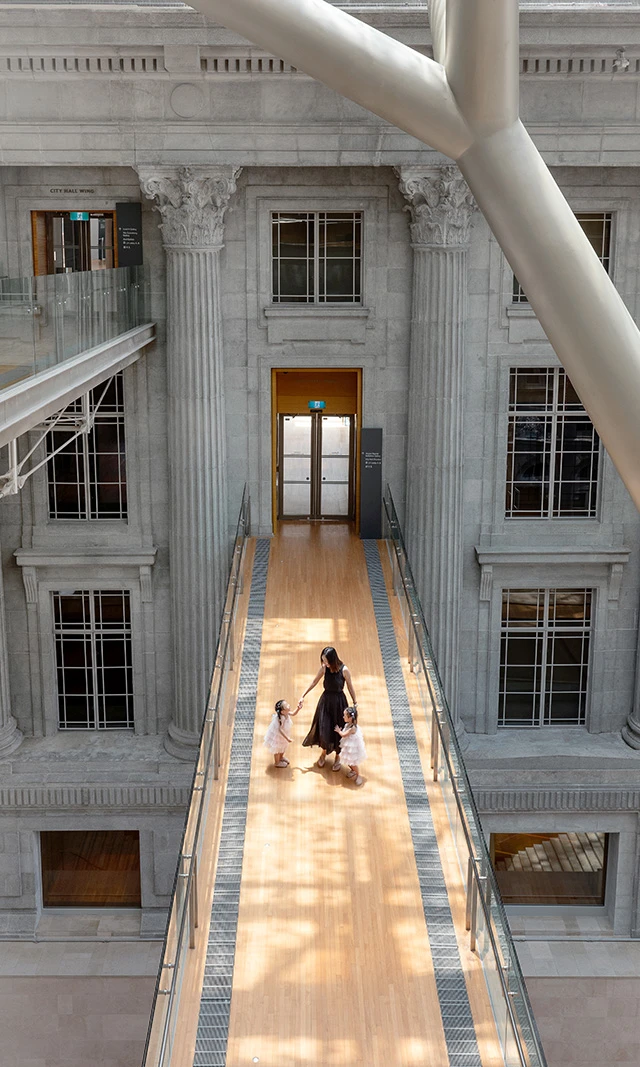
The opening of National Gallery Singapore comes at a time of great significance for Singapore, in her 50th year of independence. What is the relationship of art to a nation like Singapore and how can we understand its role in the last fifty years? These are some of the questions that the exhibition Siapa Nama Kamu? Art in Singapore since the 19th Century seeks to address. The exhibition and this accompanying publication aim to provide visitors with an understanding and appreciation of Singapore art, its development and links with Southeast Asia, Asia and other parts of the world.
Read more
This website uses cookies to ensure you get the best experience. View our privacy policy