


Section 01
Introduction
The Nanyang, translated literally as the “South Seas,” is an old Chinese trading denomination for the Southeast Asia region. Taking its compass direction from the position of China, the Nanyang lay to the south, encompassing the areas where the Chinese traded: Thailand, Indonesia, Singapore, Malaya (now Malaysia) and the Philippines. Although the term is rarely used now, replaced as it is by newer national definitions of territory, it continues to evoke a history of immigrant Chinese cultural identity in the region during the early 20th century.1 In art history, Nanyang art holds a special significance as the first critical period in Singapore’s art development that shows a conscious attempt by artists to create a local art discourse.
Section 02
Modern Perspectives: East Meets West
Based on existing archival records, Chinese artists have been present in Malaya from as early as the mid-19th century.2 They were mainly commercial artists who remain largely unknown in the history of art but their activities can be seen through the production of commissioned artworks such as ancestral portraits and natural history drawings of the period, including major artworks in the Sir Stamford Raffles and William Farquhar collections. Yeo Mang Thong’s “A Study of the Art Scene of the Chinese Society in Singapore towards the End of the 19th Century (1887–1899)” is an illuminative piece of research that attempts to trace the roots of early Chinese artists in Singapore and the different types of activities they engaged in during the late 19th century.3 His research focuses primarily on the print industry and examines how artists were engaged as graphic illustrators for advertisements, or as calligraphers in the production of writing for commercial signboards.
At the turn of the 20th century, sociopolitical changes in China led to the presence of professionally-trained artists in the region, often en route from China to the great cultural centres of Europe for further education. They were part of the first wave of artists trained in modern art academies in China.4 Singapore, as an established port along the major shipping routes between China and Europe, thus started to see a growth in its art activities. Artists who visited Singapore then include eminent painters such as Xu Beihong who eventually cultivated a long-standing patron relationship with local businessman Huang Manshi. For these artists, the growing affluence of overseas Chinese communities made them important sources of artistic patronage. This can be seen during the early years of the Second Sino-Japanese War, when a number of artists such as Liu Haisu travelled from China to the British Straits Settlements to raise funds for war-relief efforts back home.
The outbreak of the Second Sino-Japanese War was a watershed in the art development of Singapore and Malaya. This event led to a large-scale exodus of cultural figures from China, who took sanctuary in Singapore and Malaya and eventually settled here. This period also saw the formation of the Nanyang Academy of Fine Arts (NAFA), an art school which was modelled after Xiamen Art Academy and became a major centre for Nanyang art development during the mid-20th century.5 As official involvement in the arts by the British colonial government then was fairly limited, formal artistic training in Singapore and Malaya was largely precipitated by the arrival of these Chinese artists.6 The significance of these artists’ backgrounds and the uniqueness of their contributions to Singapore are best understood against the wider context of change occurring in China in the period.
During China’s great reform at the start of the 20th century, art education was one of the fields that the Chinese government sought to modernise by establishing modern art academies that followed the pedagogy of Western art academies.7 Modelled upon European and Japanese art schools, the new Chinese academies became the driving force for artistic revolution within the country. The programme of these new schools featured a mixed curriculum of Western and Chinese art subjects, mostly divided into separate departments of study. For Chinese art subjects, students studied classical calligraphy and ink painting. The instruction of Western art subjects focused on realist techniques in perspective and the study of structure and composition. Other Western techniques, such as plein-air painting, portraiture and life drawing were also introduced in the curriculum. Students usually took subjects from both Chinese and Western art to expose themselves to different forms and philosophies of art. This two-pronged approach was designed to enable students to gradually and naturally develop an amalgam of the two traditions, one that would fit the prescribed model of the new Chinese culture. The image of the modern Chinese artist thus came to be regarded as one who was at equal ease with the aesthetic concepts and practice of both Chinese and Western art.
Section 03
Spirit of Experimentation in Nanyang Art
Synthesis in Nanyang art is a trait that arose as a result of early art education reforms in China. The philosophy of Chinese and Western cross-cultural dialogue initiated by the Chinese art academies eventually found its way overseas through migrant Chinese artists. In Singapore, it was passed down to a new generation of artists through training channels such as the NAFA. Lai Foong Moi, NAFA’s first student to travel to France on a scholarship, is one example of a latter-period artist who followed this tradition.8 Her work Still Life (fig. 1), shows a European sculpture in the foreground and a Chinese ink painting hanging in the background.
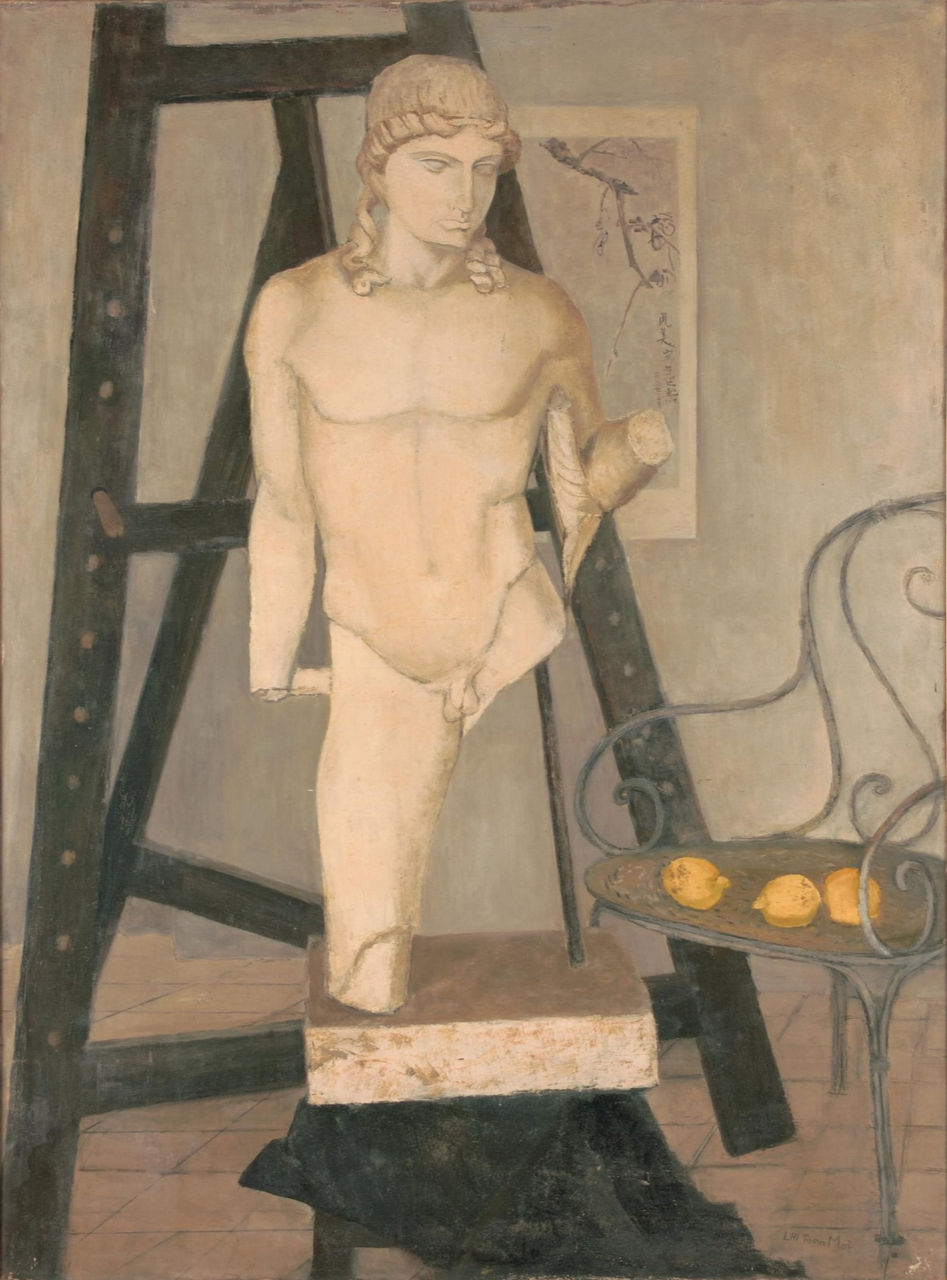
Her work Still Life (fig. 1), shows a European sculpture in the foreground and a Chinese ink painting hanging in the background.
Fig. 1. Lai Foong Moi. Still Life. Undated. Oil on canvas, 130 × 96.8 cm.
The two objects refer to the duality of artistic sources that inform her artistic identity. Interestingly, while the philosophy of Chinese and Western artistic dialogue continued to evolve in Singapore and Malaya, it eventually declined in China during the mid-20th century as a result of the Cultural Revolution and the growing influence of Social Realism.
The first scholars who attempted to classify the artistic approaches of the Nanyang artists as a group within an art historical framework are T.K. Sabapathy and Redza Piyadasa. In 1979, Sabapathy and Piyadasa organised a survey exhibition of Nanyang art at the Muzium Seni Negara Malaysia. In his comments in the accompanying exhibition catalogue, Sabapathy refers to the use of pictorial schemas by the Nanyang artists, and their drawing on the School of Paris styles and Chinese ink tradition for artistic inspiration. He notes:
This remark suggests that the creation of Nanyang art is based on a strategic selection of different styles and approaches, chosen for connotations and aesthetics that suit each artist’s sense of expression. Furthermore, as each Nanyang artist seeks his or her own interpretation of balance between Chinese and Western art, the process produces artworks with distinctly different approaches. This also accounts for artworks completed in a broad range of mediums (oils and ink) and styles that are classified as Nanyang art.
To illustrate this point, a study of artworks by three artists, Lee Man Fong, Cheong Soo Pieng and Liu Kang, shows their different approaches in the use of ink and oils, and how each artist sought to combine Chinese and Western aesthetic sensibilities in their art. Lee Man Fong was born in Guangdong, China. As a child, he travelled with his family to Singapore before eventually moving to Jakarta, Indonesia in 1932. Lee used the Western medium of oil for richness and subtlety in tonal colour, whilst relying on Chinese ink techniques to achieve a distinct and lively linework. Kehidupan di Bali (Balinese Life) (fig. 2 image not reproduced in the digital edition) is a classic example of Lee’s masterly use of brushwork.
Cheong Soo Pieng, who moved to Singapore from Xiamen, China after World War II, adeptly translated core concepts and techniques of both Chinese ink and Western oil idioms. Landscape (fig. 3) is a work in oil, but draws from the tradition of landscape painting of the Song Dynasty in its detailed rendering of the mountain that dominates as the central subject. In comparison, his ink work Fishing Valley (fig. 4), features the use of Cubist geometric forms to depict the kampong (village) houses, thereby reducing the landscape into a series of patterned forms.
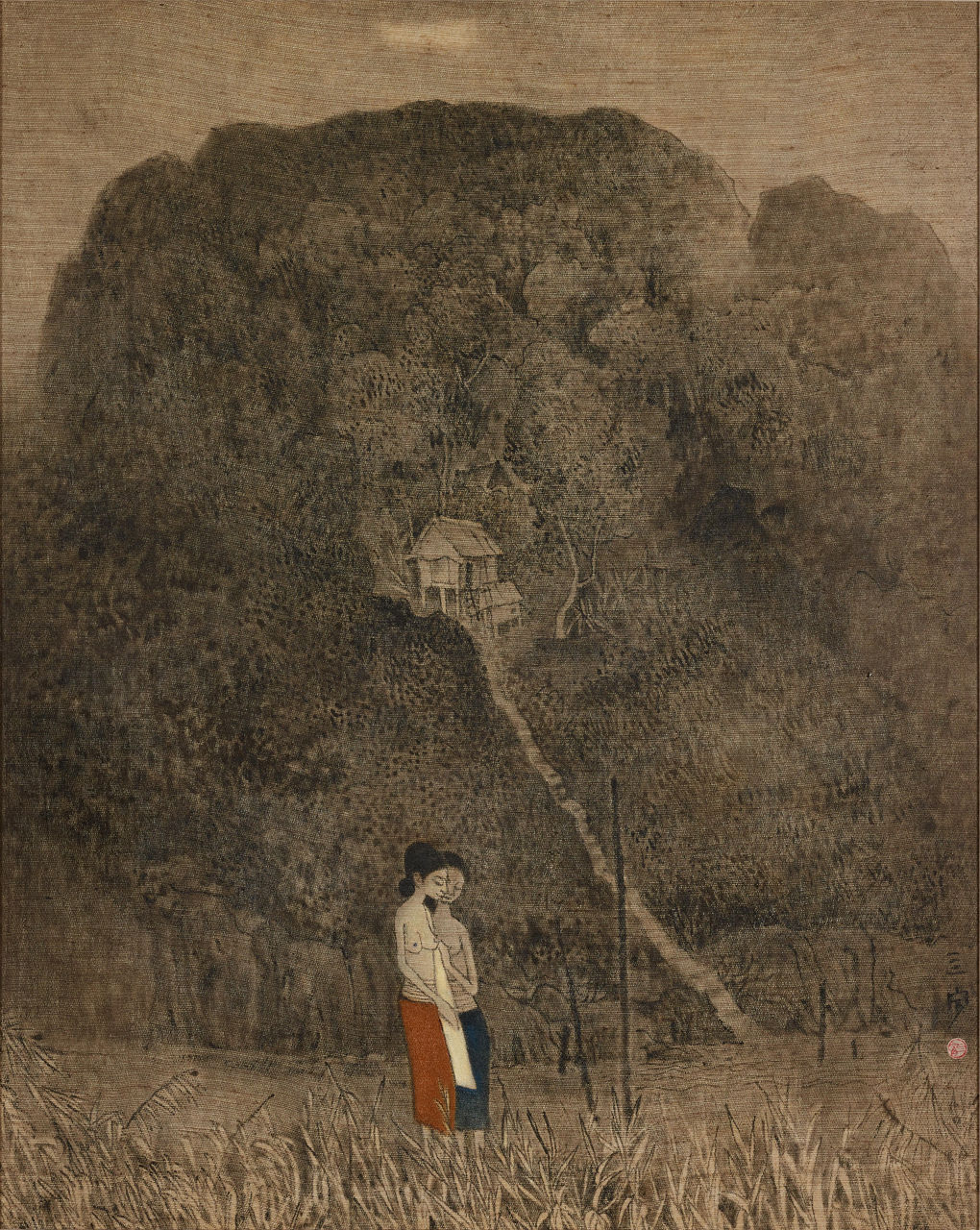
Landscape (fig. 3) is a work in oil, but draws from the tradition of landscape painting of the Song Dynasty in its detailed rendering of the mountain that dominates as the central subject.
Fig. 3. Cheong Soo Pieng. Landscape. 1981. Oil on canvas, 100.5 × 80.5 cm.
1 2
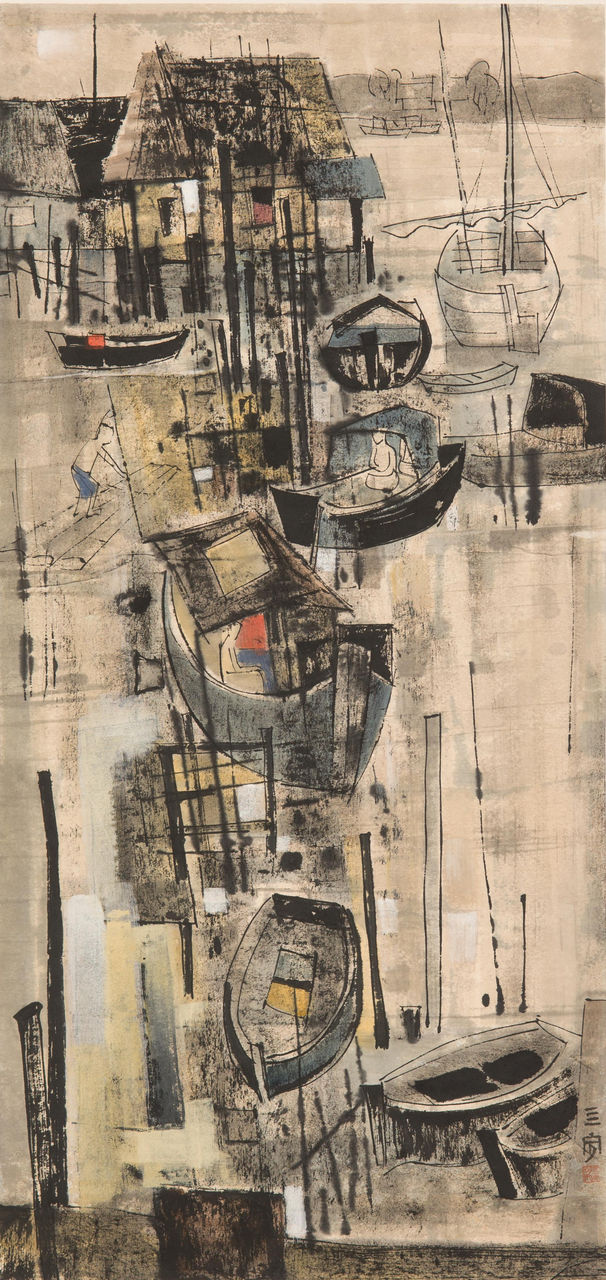
In comparison, his ink work Fishing Valley (fig. 4), features the use of Cubist geometric forms to depict the kampong (village) houses, thereby reducing the landscape into a series of patterned forms.
Fig. 4. Cheong Soo Pieng. Fishing Valley. Undated. Ink and pastel on paper, 126 × 58 cm.
2 2
Liu Kang lived in Muar, Malaysia as a young boy and later returned to China to study at the Shanghai Academy of Fine Art and Xinhua Art Academy. In his seminal work Life by the River (fig. 5), Liu used the pictorial format of the Chinese handscroll to compose the landscape rendered in oils.10
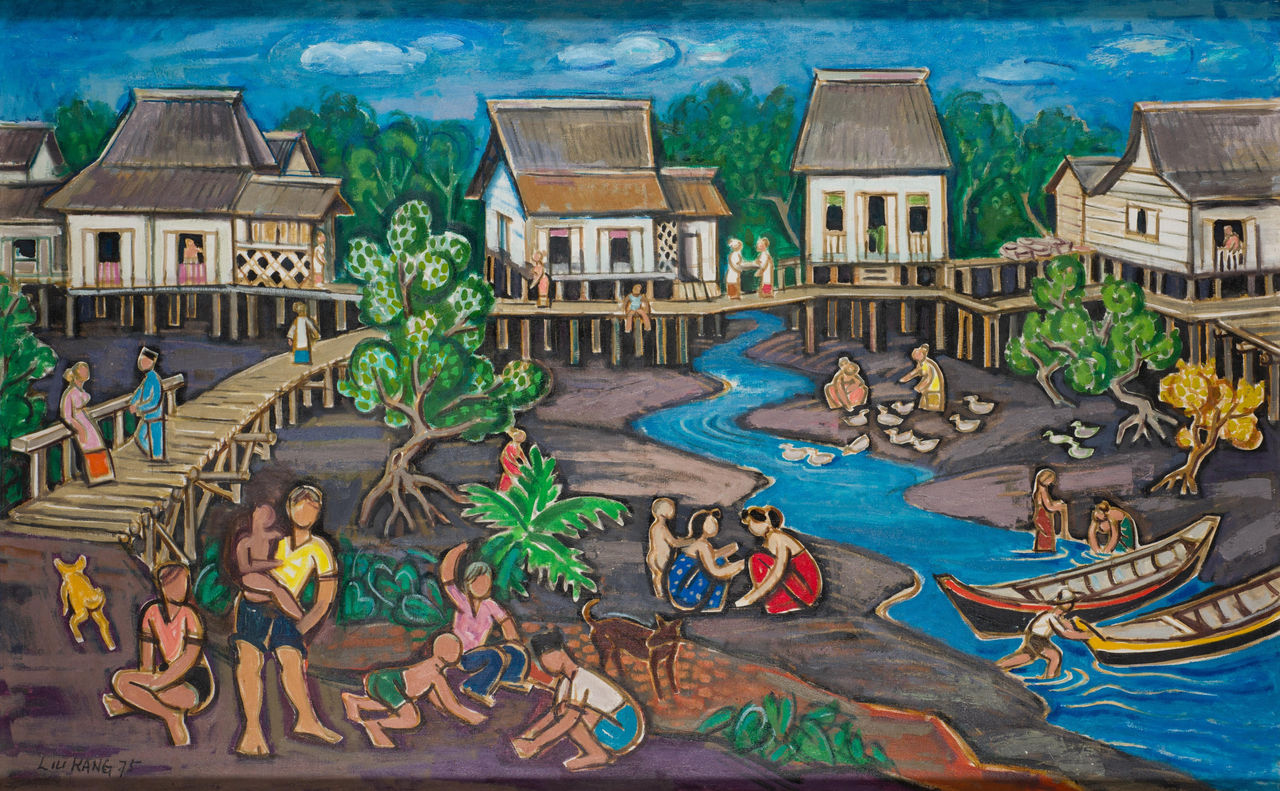
In his seminal work Life by the River (fig. 5), Liu used the pictorial format of the Chinese handscroll to compose the landscape rendered in oils.10
Fig. 5. Liu Kang. Life by the River. 1975. Oil on canvas, 126 × 203 cm. Gift of Liu Kang.
Unlike Western realism and its use of a single-focal point to focus the viewer’s attention, Life by the River employs multiple focal points across the landscape. In this artwork, the bridge acts as an important narrative device that weaves through the landscape, drawing together the different pockets of activities to express a sense of a kampong community. Together, these artworks demonstrate the range of Chinese and Western art influences in Nanyang art.
The fluidity of Nanyang art, as a type of art historical classification, is demonstrated by its open-ended nature that puts both oil and ink works within a single frame of discussion. There are also other notable issues when Nanyang art discourse is couched solely in aesthetic terms. Writings on Nanyang art typically stress the importance of Chinese and Western art influences in its development but these writings often revolve around assumptions on painting format. However, this approach becomes highly problematic when other forms such as sculpture, woodcut, batik art and photography are brought into the conversation. These peripheral areas can only be included when the framework for Nanyang art discourse is transferred from stylistic expression to creative motivation as the basis for Nanyang art.
Section 04
The Idea of the “Local” in Nanyang Art
The relationship between creative motivation and Nanyang art practice was first proposed by Sabapathy who states, “the ‘localness of the place’ was consciously adopted as a programme for activity, manifesting an aesthetic position by all the Nanyang artists.” 11 The idea of the “local” can be approached in two ways. In geography, the term “location” is defined as a physical location on a map, or as a relative location.12 It is this latter quality that is of interest to our discussion. Relative location defines its position in relation to other areas; it is therefore of variable nature because the notion of what the “local” encompasses can change at different points in the area’s history and its interactions with the surrounding areas. As such, “local” identity becomes a negotiable quality, and is open to a variety of interpretations.
Nanyang art may thus be established on this ambiguous notion of “localness,” resulting in an approach to subject matter that expands over time, starting with Malaya and eventually encompassing the entire Southeast Asia region. During the early period of Nanyang art development in the 1920s and 1930s, overseas Chinese literature started to discuss the concept of “Nanyang colour” as a literary device to describe the Southeast Asian environment; artists eventually shared this approach in their artworks.13 The concept of “Nanyang colour” was the result of a conscious attempt by cultural figures towards establishing a diasporic Chinese identity in the arts and distancing themselves from mainland Chinese culture.
In art, the newly produced artworks eschew the mountainous landscapes of the classical masters and instead, commemorate the tropical Malayan landscape, focusing on coastal scenes and coconut groves.14 Terms like nanyang fengwei (Nanyang style and taste) came to be used to describe the selection of native themes and subject matter in art. Chen Chong Swee was one of the early Nanyang artists who introduced the iconographical use of local flora, such as the coconut tree, as a recurrent symbol of the tropical landscape in his ink works.
Whilst early artists focused on the depiction of Malayan subject matter, this interest in local subjects gradually grew to include those from the various Southeast Asian countries, a development further facilitated by improved transport networks within the region that enabled greater mobility. Art historians often consider the 1950s and 1960s as a significant period in the development of Nanyang art, and a time of great exploration and innovation for the Nanyang artists.15 At the same time, the formation and growth of major art societies during this period provided artists with the structural and collaborative support to undertake major painting trips. As a result of these various trends, the derivation of subject inspiration through travel became a core part of the art-making process in Nanyang art practices in the later years.
Section 05
Representations of Southeast Asian Landscape in Nanyang Art
When espousing the concept of “local” in subject matter, it is intriguing to note that the Nanyang artists, in reality, often viewed Southeast Asia from the point of a tourist, documenting their thoughts and memories of these new experiences in published essays and personal correspondences. As such, their approach can be described as an outsider’s perspective which creates an incongruity between their idea of “localness” and an inherent exoticising of their subject matter. This point is made more critical when considering Nanyang art’s depiction of Southeast Asia as a tropical paradise in contrast to the wider phenomenon of its decolonisation during the mid-20th century. One commonly articulated criticism of Nanyang artists is how their romantic portrayal of life in Southeast Asia is often delinked from the social and political turbulence of Malayan society then.16 While this is not strictly accurate – Nanyang artists did on occasion paint artworks dealing with social issues – in general, Nanyang artists mostly focused on capturing the rural aspects of Southeast Asian life and landscape in art. This paradoxical position occupied by Nanyang artists is best understood when considering the roots of Nanyang art’s influences and motivations.
Nanyang art discourse is mainly shaped by concepts of “tropical paradise” at two historical junctures. The concept was first introduced via overseas Chinese literature as a way to depict the realities of life in the Nanyang region. This thinking is rooted in the ideology of art as a medium that serves social and political changes, as espoused by the influential early 20th-century Chinese writer Lu Xun; art should reflect critical contemporary issues, rather than pay homage to outdated notions of tradition. With this form of thinking, the rendition of tropical landscapes became seen as a true reflection of the daily life of overseas Chinese in the tropics, and the four seasons of classical Chinese art were replaced with brightly coloured sunlit scenes of rubber plantations and coastal shores. In his address to the first graduating class of NAFA, Lim Hak Tai said, “Art must possess the spirit of resistance to allow it to become a finely edged weapon, to establish the value of fine art, and to further give it depth in meaning.” 17 However, this concept was eventually conflated with a second concept of “tropical paradise,” which can be traced to French post-Impressionist artist Paul Gauguin and primitivism in modern art.18 Gauguin was a key figure of the French avant-garde movement, best known for his series of artworks on Tahitian inhabitants produced when he was living on the French Polynesian island. Gauguin’s secluded lifestyle became one of the inspirations for the mythology of a tropical paradise in modern art, a constructed notion of a locale far removed from Western decadence and steeped in the innocence of “primitive” living in non-industrialised cultures. Researchers describe primitivism in art as a platform where Western artists are able to enact desires typically repressed by social mores, such as sexual desires and the resulting eroticisation of the indigenous body in art.19 During the early 20th century, the Indonesian island of Bali became a popular destination that attracted many international artists to the region, and led to the eventual establishment of an Indo-European artist community there. Key figures in the community include Walter Spies, Miguel Covarrubias, Rudolf Bonnet and Adrien-Jean Le Mayeur de Merprès. Like Gauguin, these artists helped perpetuate the popular image of Bali as a lush and idyllic corner of Southeast Asia.
The paintings by Le Mayeur, in particular, captivated the imaginations of Nanyang artists such as Liu Kang. During the 1930s, Le Mayeur organised a series of successful exhibitions in Singapore that garnered wide media attention. After the war, Liu and three of his fellow artists, Cheong Soo Pieng, Chen Chong Swee and Chen Wen Hsi, visited Le Mayeur at his house in Bali as part of the group’s painting trip to Indonesia in 1952. This initial excursion to Bali introduced new sights that enchanted the four artists. The women of Bali, in particular, feature as the dominant subject matter in the paintings produced on the trip (Liu Kang subsequently wrote an essay in 1953 about the charms of bare-breasted Balinese women and his regret over the loss of this tradition due to the growing effects of civilisation).20 Like many Indo-European artists, the four artists focused mainly on portraying the rural landscape, the cultural practices of the Balinese inhabitants and local architecture, which were viewed as quintessential Balinese icons. The artists rarely dealt with political or social issues in their artworks, which would have required in-depth knowledge of Balinese history, its contexts and social structures. Artworks from the Bali trip thus became a product of rural imaginings of Balinese life. Traveller and writer Paul Theroux once described exoticism as the “charm of the unfamiliar.” 21 Similarly, the Nanyang artists’ intention of painting the reality of their Southeast Asian environment was overshadowed by their fascination with the foreignness of the new cultures they encountered.
Nanyang artists often vacillate between two points of view – they profess to represent life in the tropics yet there is often a sense of the exotic in their portrayal of subject matter. A critical question that must then be asked is how the story of Nanyang art should be positioned alongside parallel artistic developments of other ethnic groups in Singapore and across the region. How are their concepts of “local” similar or different from those presented by the Nanyang artists? Examples of other early artists active in Singapore are largely found in the Malay community, including Mahat bin Chadang who was founding president of Persekutuan Pelukis Melayu (Society of Malay Artists) in 1949. Another compelling narrative can be told through the perspective of regional networks formed by sojourning artists from other parts of Southeast Asia in Singapore, such as Latiff Mohidin from Malaysia, and also of those who eventually settled in Singapore, such as Aman Ahmad (Pak Man) from Indonesia. These narratives are of particular interest to Singapore art in terms of understanding interweaving cross-border influences, and the impact of various non-European art centres on Singapore’s art development. All these are important areas for future research – critical knowledge which will serve as a counterpoint to Nanyang art discourse.
Section 06
Nanyang Art and Southeast Asian Material Culture
The success of the 1952 Bali trip and its resulting exhibition, Pictures from Bali, in 1953 eventually inspired other Nanyang artists to follow in their footsteps. These include the Ten Men Art Group, an informal grouping of artists who organised a series of painting trips to different parts of Southeast Asia between 1961 and 1976.22 A key effect of the 1952 Bali trip was the way it focused artists’ attention on the richness of Balinese culture, and helped propagate the use of Southeast Asian material culture as an inspiration for art. Cheong Soo Pieng’s iconic figure-type – the sloe-eyed Asian beauty with attenuated limbs – was most likely derived from Indonesian golok stick puppets he encountered during his travels. Liu Kang’s drawings from the 1952 Bali trip, now residing in the national collection, include detailed sketches of numerous Indonesian cultural artefacts. The leader of the Ten Men Art Group, Yeh Chi Wei, amassed an extensive collection of artefacts from these trips, which he used as part of his artistic process. Like the Western artists who started to look towards non-Western cultures as a new source of creative inspiration, Nanyang artists drew on primitivism for artistic stimulus as well as a way of creating a localised art.
In the early period of Nanyang art development, artefacts were generally recorded in a documentary manner, appearing as objects in paintings. However, as the Nanyang artists’ understanding of Southeast Asia deepened over time, the integration of artefacts in their artworks became more sophisticated. Later approaches by artists such as the Ten Men Art Group extend beyond realistic representation towards greater incorporation of motifs and detailing as part of the artwork’s overall stylistic approach. This phenomenon coincided with the growing interest in abstraction in Singapore from the mid-1950s onwards. This is seen in Yeh’s Drummer (fig. 6) which depicts two hanging textiles and a wooden emblem behind a musician who is seated cross-legged on the floor in a longhouse.
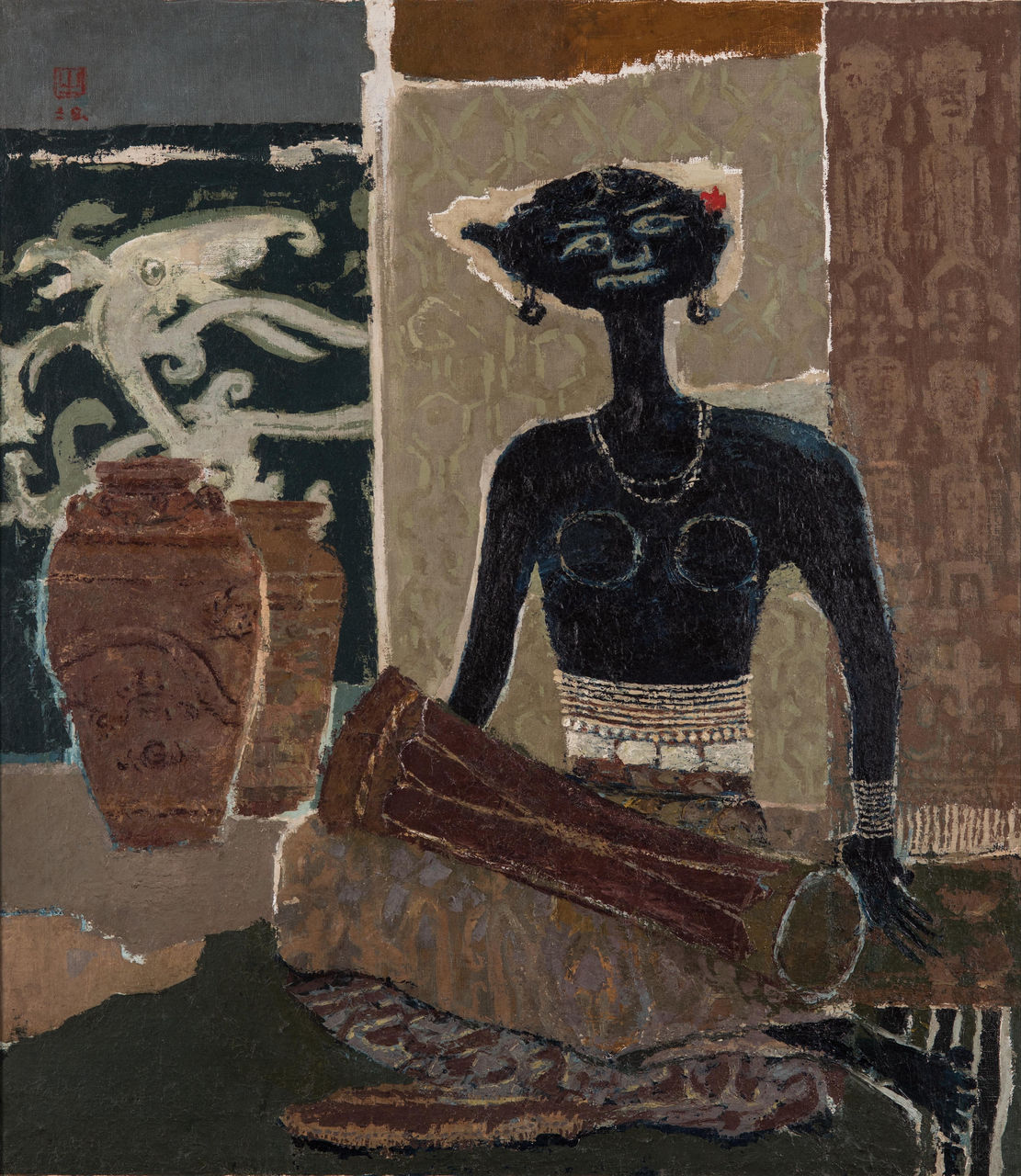
This is seen in Yeh’s Drummer (fig. 6) which depicts two hanging textiles and a wooden emblem behind a musician who is seated cross-legged on the floor in a longhouse.
Fig. 6. Ye Chi Wei. Drummer. c. 1965. Oil on canvas, 104.5 × 91.5 cm.
The features of the figure are based loosely on details found in indigenous sculpture, while the designs of textile artefacts are transformed into a play of shapes in the background. In creating this painting, Yeh drew inspiration from a wide range of cultural sources such as Han Dynasty carvings and Javanese batik.23 The resultant artwork synthesises Asian and Western aesthetics, and incorporates Southeast Asian cultural inspirations drawn from his travels. Significantly, later artworks by the Ten Men Art Group from the 1970s came to be inspired by the broader range of Asian civilisation histories, and feature subject matter from heritage sites across Asia, including Angkor Wat in Cambodia and the Ajanta Caves in India.
An example of a commonly used artefact in Nanyang art is batik.24 Nanyang artists were drawn to the textile due to its highly decorative nature and symbolic value as a local artefact. Hence, batik sarongs and production factories were often used as subject matter in Nanyang art. This is seen in Liu Kang’s Artist and Model (fig. 7) where particular attention is paid to the pattern of the batik sarong worn by the model.
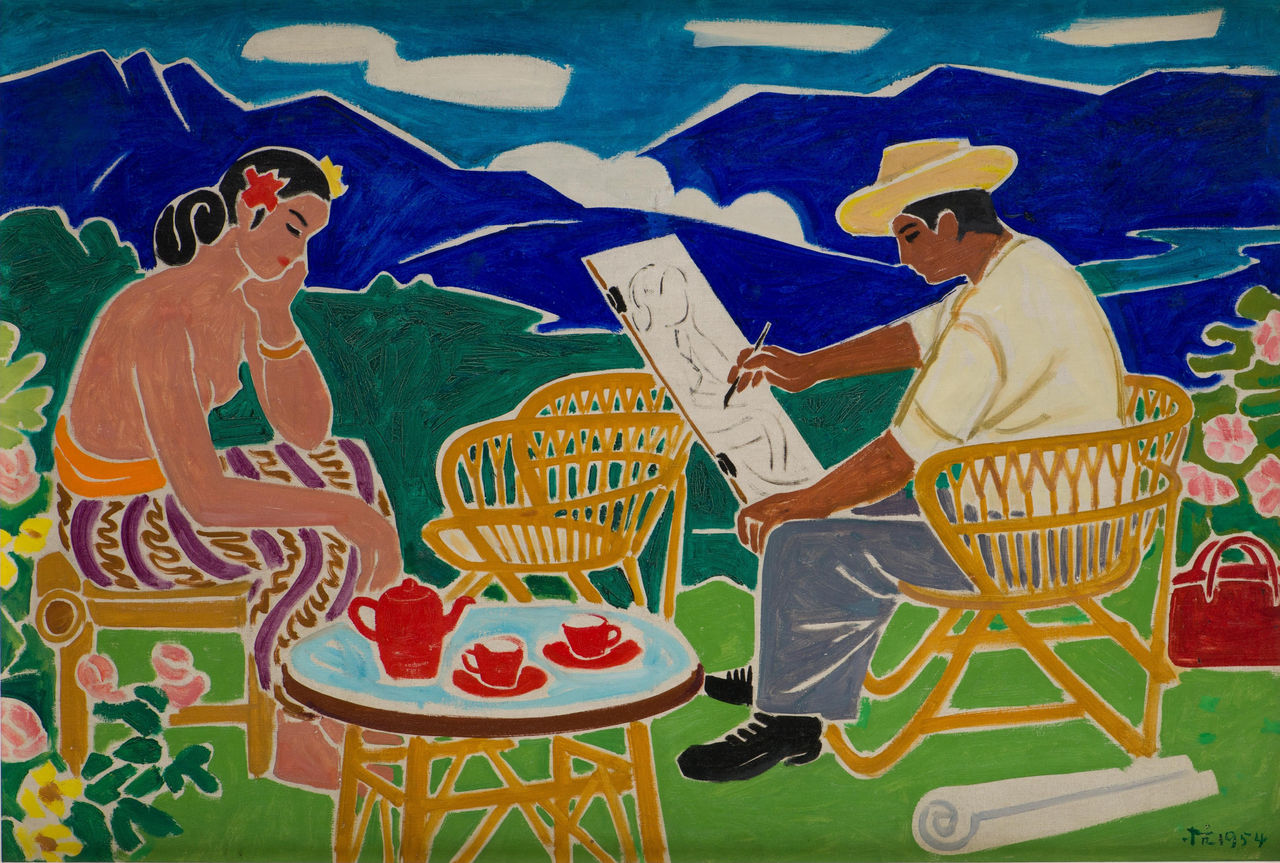
This is seen in Liu Kang’s Artist and Model (fig. 7) where particular attention is paid to the pattern of the batik sarong worn by the model.
Fig. 7. Liu Kang. Artist and Model. 1954. Oil on canvas, 84 × 124 cm. Gift of Shell Group of Companies.
In addition, the wax-resist dye pattern of the batik sarong is carried through into its surroundings via the white outlines of the figures and landscape; the white outlines serve to break down the various elements within the painting into flat planes of colour. The incorporation of batik sarongs in painting is possibly one factor that led to the increased stylistic emphasis on linework, especially white outlines, in Nanyang art. The relationship between batik and artistic expression can be further seen through the invention of batik art. Batik art was pioneered by Penang artist Chuah Thean Teng in the post-war period, and is a form of painting using the batik technique that became popular in the 1950s and 1960s. While batik art is not synonymous with Nanyang art – batik art has a separate history of development that includes abstract and contemporary phases – there are many confluences between the two areas in terms of exploring local expressions in art.
The Nanyang artists’ interest in Southeast Asian material culture can be considered as an extension of cross-cultural learning during the post-war years, fuelled by an increasing interest of the overseas Chinese community towards other ethnic groups in Singapore. This process is part of the wider historical phenomenon of Malayanisation, which occurred as numerous Chinese immigrants renounced their ties with China to settle in Singapore and across Malaya. At the macro level, the search for national identity that emerged as part of Singapore’s and Malaya’s move towards independence also played a fundamental role in shaping the arts discourse. The creation of a multicultural Malaya out of a largely immigrant society, along with the hope of forming a unified Malayan identity to supersede those of the different ethnic cultures, represented key concerns of the period, and are part of the broader contextual events that shape the historical development of Nanyang art.
Section 07
Conclusion
The development of Nanyang art parallels some of the most important periods of Singapore’s history. The gradual decline of Nanyang art was also triggered by changing times. Even as Nanyang art achieved maturity during the 1950s and 1960s, its position became challenged by the emergence of new competing art influences such as Social Realism which gained currency with the younger artists. Scenes of the tropical landscape in Southeast Asia which had once charmed the early immigrant artists with their exotic novelty, had lesser resonance with a generation of Singapore-born artists who lived through the turbulent period of decolonisation and independence, and who were consequently more introspective in their contemplation of local social issues. For those artists who came into contact with the international art scene through overseas studies and travels during the 1960s, abstraction offered yet another new way forward in art. Some of the original Nanyang artists eventually developed their practices along these trajectories. Cheong Soo Pieng, for example, started to experiment with abstraction as a result of a trip to Europe in the early 1960s. The artist continued to paint works that are characteristic of Nanyang art but also pursued abstraction at the same time. In this manner, Nanyang art practices were superseded by new concerns and thinking in art. At its height, Nanyang art reflected a particular historical period and world view that has since passed, but its spirit of enquiry into the formation of local cultural identity in relation to geographical place continues to be relevant in today’s globalised world.