


In 1949, Lim Hak Tai, then principal of the Nanyang Academy of Fine Arts (NAFA), proclaimed in a live broadcast titled Art and Life:
Lim’s proclamation was a harbinger of a new art movement, propelled by a generation of young artists who sought new ways in thinking about and making art that will resonate and engage with their social and cultural milieu. Nationalism, anti-colonialism, shifting identities and the making of new ones opened up multiple paths to modernity in Singapore after World War II.2 Lim Hak Tai did not have to wait long for the birth of this new art movement.
Section 01
Real Concerns: Social Realism as an Artistic Practice
The new art movement envisaged by Lim that engaged with the social and political conditions of Singapore and Malaya was Social Realism, a movement intent on reflecting the life and times in Singapore. Proponents of Social Realism advocated a realist-style of painting and a socially engaged form of practice that directly involved their subjects to create works that comment on social issues. For example, to research into the struggles of the working classes, artists interacted with workers to understand and gain a lived experience of their problems. The Chinese Middle Schools’ Graduates of 1953 Arts Association (SCMSGAA), comprising students from the local Chinese middle schools, championed Social Realism as a way to represent the realities of the working class. In 1956, SCMSGAA organised a fund-raising exhibition at the Chinese Chamber of Commerce.3 The foreword to the SCMSGAA’s exhibition catalogue proclaims: “Art belongs to the people – it is the public, and should serve the public,” and “We are prepared to commit all our efforts to help Malaya gain her independence and her process of nation-building.” 4 The SCMSGAA’s manifesto which was part of the foreword, proclaimed that art defined the nation (Malaya) and will propel the process of nation-making. They believed that art had the power to effect social change. The SCMSGAA ceased its activities after the exhibition, probably due to its strong criticisms of the colonial administration and its perceived left leanings in its artworks. A new art society, the Equator Art Society (EAS), comprising many members previously from the SCMSGAA was registered on 22 June 1956.5
Section 02
Realism: History Painting from Below
Artists who sought the path to modernity through realism developed the genre of history painting and reinvented its conventions by referencing art books featuring Russian realist history painters such as Ilya Yefimovich Repin.6 National Language Class (fig. 1) by Chua Mia Tee depicts a group of students eager to learn Bahasa Melayu from a teacher as part of the Ministry of Culture’s efforts to promote the use of it as the national language in anticipation of the political and cultural union between Singapore and the Malay Peninsula.
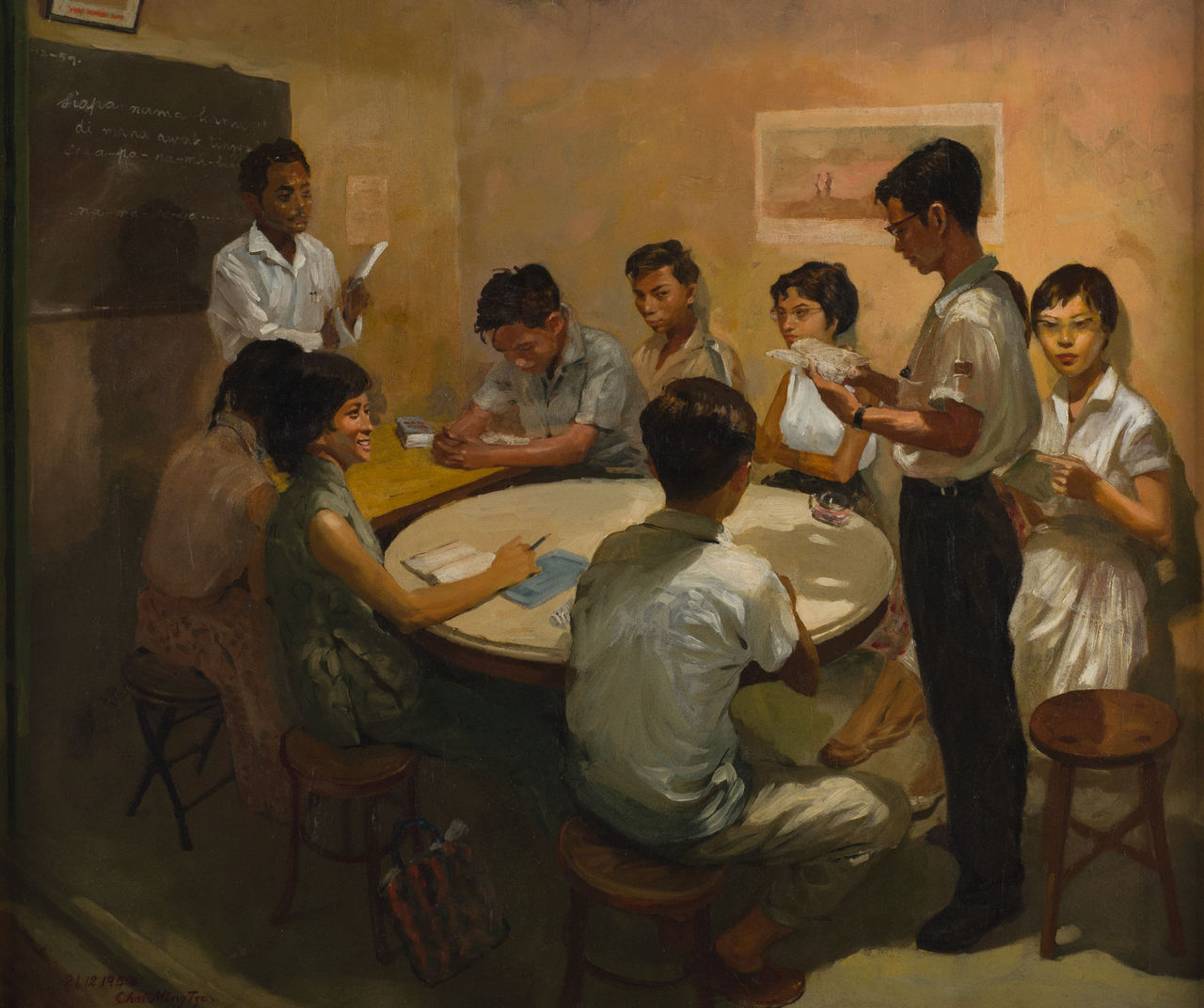
National Language Class (fig. 1) by Chua Mia Tee depicts a group of students eager to learn Bahasa Melayu from a teacher as part of the Ministry of Culture’s efforts to promote the use of it as the national language in anticipation of the political and cultural union between Singapore and the Malay Peninsula.
Fig. 1. Chua Mia Tee. National Language Class. 1959. Oil on canvas, 112 × 153 cm. Gift of Equator Art Society.
Scribbled on the blackboard are the questions: “Siapa nama kamu?” (What is your name?) and “Di mana awak tinggal?” (Where do you live?). On the surface, these are basic questions typically asked when meeting someone for the first time but these are also questions concerning one’s cultural identity and ethnicity, as well as one’s sense of place. The process of Malayanisation was taking off in the late 1950s and the Ministry of Culture, established in 1959 with Sinnathamby Rajaratnam as the Minister for Culture, was promoting Bahasa Melayu through the “National Language Campaign.” The painting portrays the fervour to learn and adopt Bahasa Melayu as the national language of Malaya, in place of other contesting languages widely spoken at that time.7 The drive to learn Bahasa Melayu, which was regarded as an indigenous language and a symbol of anti-colonial resistance, can be inferred from the standing student who has come to attend class despite being in mourning, as indicated by the square piece of blue cloth on his left sleeve. This painting illuminates the social and political significance of language and its relation to culture and identity. The embracement of the new national language in Singapore by the non-Malay speaking Chinese community embodies their determination to sever their cultural and political loyalties to China (often referred to as the Motherland) for the creation of a Malayan culture in their newfound homeland. This was a critical victory for the government as the creation of Malaya, which includes Singapore, Sabah and Sarawak, will form a supranational state with enough military strength to defeat the communists and provide a stable environment for economic prosperity.
For his painting National Language Class, Chua Mia Tee drew inspiration from his experience of attending Malay-language classes held in attap houses.8 Unlike conventional history painting that depicts important historical events on a grand scale, such as battle scenes, Chua elevates a classroom scene from the everyday to the monumental. Other history paintings of everyday scenes by artists from the EAS include: Lai Kui Fang’s Bedok Flood, Tay Kok Wee’s Picking and Koeh Sia Yong’s Here They Come! These aforementioned artists, as well as Chua, were at the forefront of reinventing the genre of history painting as “history paintings from below.” 9 The students portrayed in National Language Class were in actuality members of the EAS who had posed for Chua. The man who posed as the teacher and known to them as “Ali,” was described as an idealist that followed the activities of the EAS and shared their aspirations to use art for social justice.10 The depiction of individual identities in portraiture, especially of the common working class, portray the ordinary person as having social and historical significance and agency. This idea is pronounced in the numerous portraits exhibited by the EAS.
Section 03
Portraiture: Portraying the People
In 1958, the EAS organised its inaugural exhibition, featuring over 400 artworks, including sculptures and paintings in media such as, oils, watercolours and pastels. Portraits dominated the exhibition, and emerged as a significant genre and mode of artistic practice. Works such as Chua Mia Tee’s Portrait of Lee Boon Ngan, Tay Boon Pin’s Teh Tarik Seller and Koeh Sia Yong’s Old Man are typical of the types of portraits shown at exhibitions by the EAS. These portraits, of a student, hawker and elderly person, are representative of the familiar social groups that are part of the reality of Singapore’s social fabric. The EAS’ influence in portraiture can be traced to Russian Social Realists, such as Repin, an artist who excelled with his vivid depictions of the lives, personalities and realities of individuals deeply connected and engaged with the world that they live in. Painting Class (fig. 2) by Lim Yew Kuan portrays the importance of studio-based practices that were taught in art academies such as NAFA, which also included portraiture and plein-air painting in their curriculum.
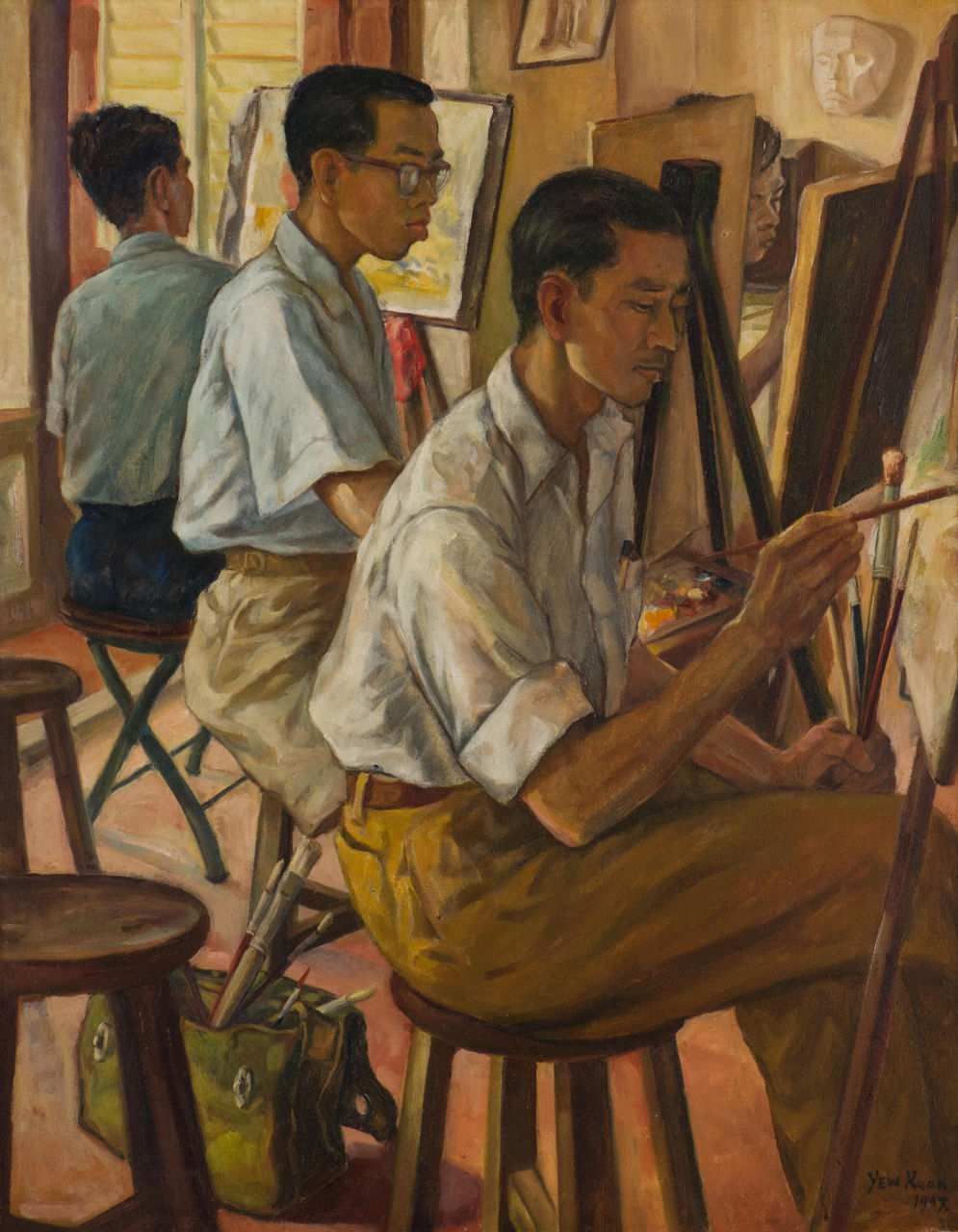
Painting Class (fig. 2) by Lim Yew Kuan portrays the importance of studio-based practices that were taught in art academies such as NAFA, which also included portraiture and plein-air painting in their curriculum.
Fig. 2. Lim Yew Kuan. Painting Class. 1957. Oil on canvas, 83 × 65 cm.
Plein-air painting and the drawing of individuals in their social environment provided the immediacy sought by the EAS artists to capture the life of a person as it actually was. Portrait drawings of various ethnicities such as, Lee Boon Wang’s Malay Man and Indian Girl, and of students drawn from life reveal the artists’ interest in mastering the proportion and volume of physiognomy through study and practice. In portrait paintings such as Road Construction Worker (fig. 3), Chua Mia Tee brings his subject to life using texture and tonal gradations to depict the worker’s weather-beaten skin and sinewy muscles with a level of detail and realism that surpasses drawings.
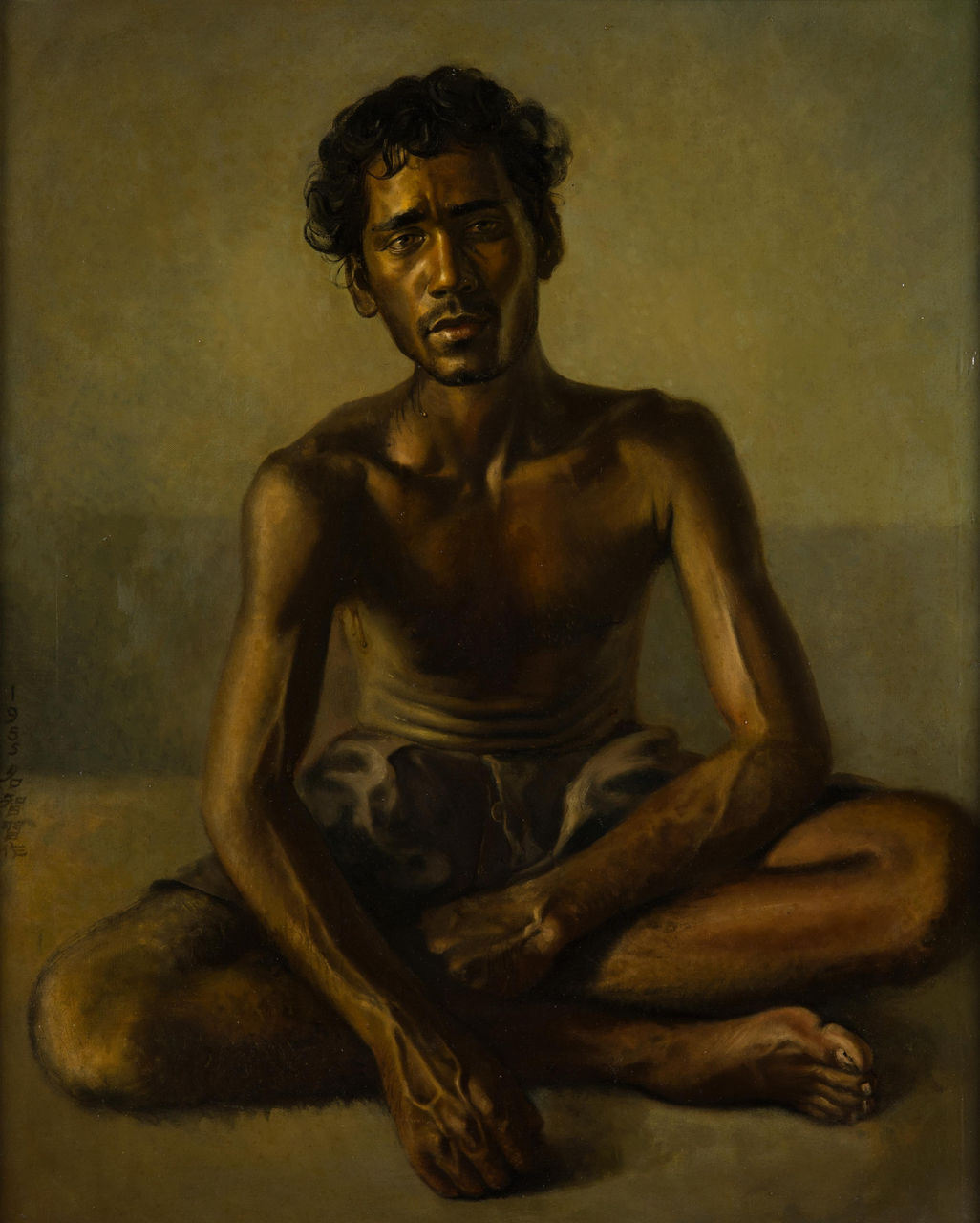
In portrait paintings such as Road Construction Worker (fig. 3), Chua Mia Tee brings his subject to life using texture and tonal gradations to depict the worker’s weather-beaten skin and sinewy muscles with a level of detail and realism that surpasses drawings.
Fig. 3. Chua Mia Tee. Road Construction Worker. 1955. Oil on canvas, 86 × 66 cm.
The unusually informal but naturalistic seating posture of the worker (cross-legged on the bare ground) departs from academic conventions of a sitter who is often portrayed as resting comfortably on a chair. In this simple and realistic portrait, the humble and down-to-earth construction worker engages the viewer with a penetrating gaze – he is dignified and empowered in spite of his poverty. Amongst themselves, artists debated how the human figure could be painted or sculpted, creating stoic self-portraits and tense profiles of family and friends to remark upon the tension between individual and collective identities.
The EAS emphasised drawing from life and being socially-engaged with the individuals depicted in their portraits. In addition to studio classes held on its premises at 56 Geylang Lorong 32 and plein-air painting sessions, they adopted new artistic practices to understand problems faced by individuals. Direct social interaction was encouraged to bridge the gap between the artist as a passive outsider who observes, to one that is personally involved and is perceived to be an “insider.” Lai Kui Fang, who taught painting to other members of the EAS, recalled rushing to the site of a flood in Bedok, an area that was prone to flooding in the 1950s and 1960s, to interview the residents who were organising a self-help group to implement measures to alleviate the flood.11 He based his painting, Bedok Flood, on his interviews with the residents (of various ethnicities), who worked together to fight the flood waters. Tay Boon Pin actually befriended a group of workers in a factory to understand their problems over a period of time before painting Workers Resting.12
Collectively, the Social Realists strove for verisimilitude through direct observation of their social environment. Potong Pasir Dairy Farmer (fig. 4) by Lee Boon Wang reveals the artist’s meticulous attention to his subject’s weather-beaten skin, wrinkles, and rugged facial muscles that bear the marks of a labourer.
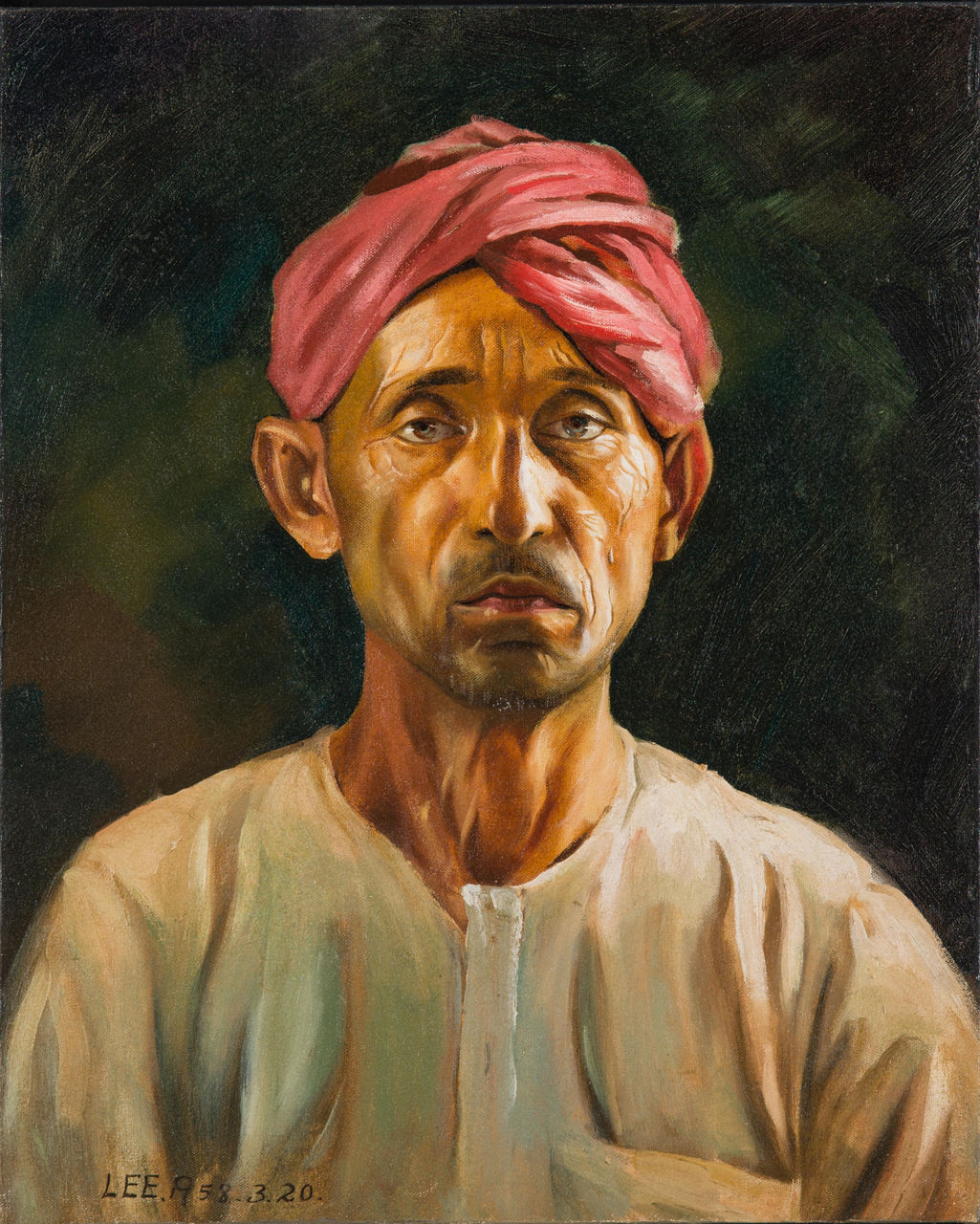
Potong Pasir Dairy Farmer (fig. 4) by Lee Boon Wang reveals the artist’s meticulous attention to his subject’s weather-beaten skin, wrinkles, and rugged facial muscles that bear the marks of a labourer.
Fig. 4. Lee Boon Wang. Potong Pasir Dairy Farmer. 1958. Oil on canvas, 54 × 43 cm.
The commitment to depict “the real” by this group of young Social-Realist artists, who were then studying at NAFA, marked a breakthrough in ways of thinking about and making art that were not taught by their teachers. Instead, they sought other sources of “the modern” by referencing art books on Peredvizhniki (also known as The Wanderers, a group of Russian realists), Gustav Courbet, Jean-Francois Millet and Lu Xun, and forged their own paths towards the depiction of “the real.” Therefore, their works are markedly different from many of their teachers at NAFA, such as Cheong Soo Pieng, Georgette Chen and Chen Wen Hsi, who did not immerse themselves in their subject’s social environment. Even in what could be considered Social Realist works by Lim Hak Tai such as, Indian Workers Clearing the Jungle (fig. 5), the workers are depicted from a distance as they toil.
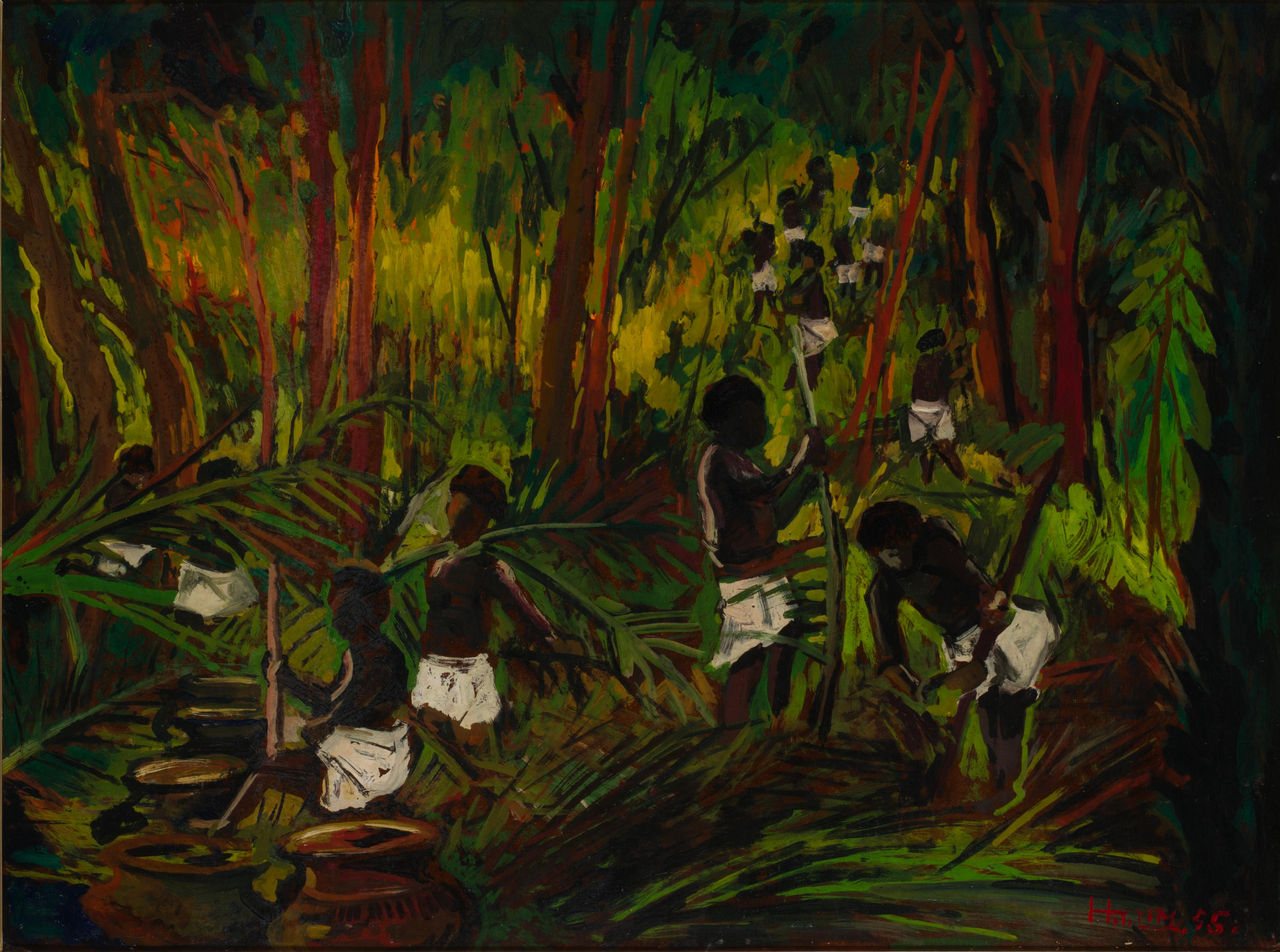
Even in what could be considered Social Realist works by Lim Hak Tai such as, Indian Workers Clearing the Jungle (fig. 5), the workers are depicted from a distance as they toil.
Fig. 5. Lim Hak Tai. Indian Workers Clearing the Jungle. 1955. Oil on board, 75 × 100 cm.
This distance from the viewer differs from the close-up portrayal of workers by EAS artists, which convey a sense of familiarity and personal connection with the subject. The collective desire to employ art for social change was also evident in woodcuts that were widely disseminated through print media, such as newspapers and magazines.
Section 04
Imprints of Everyday Life: The Woodcut Movement
The emergence of the woodcut movement in the 1950s marked an important decade in the history of Social Realism. The interest in woodcut can be first seen in 1955, with the publication of A Selection of Woodcuts and Cartoons by Singapore and Malayan Artists edited by artists Ho Kah Leong and Ong Shih Cheng (pen name Ong Yih). Both Ho and Ong were influenced by Lu Xun in seeing woodcut and cartoons as “sister arts” that could “provide art for the masses who might not have time or means to view it in galleries” and bring about improvements in society through social change.13 The works in this landmark book raise issues concerning morality, values, anti-colonial struggle, and Chinese education. Ho and Ong were also graduates of NAFA and would have adhered to Lim Hak Tai’s call to use art as “a finely-edged weapon.” 14 The dissemination of woodcuts through print media, such as magazines and newspapers, provide an alternative mode of exhibiting art other than the walls of an art gallery.
Due to the diversity of its subjects and genres, the woodcut movement is an art historically significant one in understanding the competing modes of representation and its narratives within the larger realist movement.15 Self-portraiture was featured prominently at the Six Men Woodcut exhibition held at the National Library in 1966 as the six participating artists contributed self-portrait prints. This exhibition is significant as it is the first in Singapore to feature only woodcuts. Self-portrait woodcuts by Lim Yew Kuan, See Cheen Tee, Tan Tee Chie and Choo Keng Kwang provide a mode of representation that consecrates the primacy of individual agency within the woodcut movement. This marks a shift from the woodcut movement’s focus on the society as a collective to an acknowledgement of the individual as an agent for social change. Against the backdrop of Singapore’s independence on 9 August 1965, the exhibition with its emphasis on self-portraiture suggests that the individual is recognised as a significant actor in the making of a new nation. Lim Yew Kuan’s Self-Portrait II (fig. 6) print is pulled from a woodblock cut with deep incisions to depict the rugged individual essential to nation building.
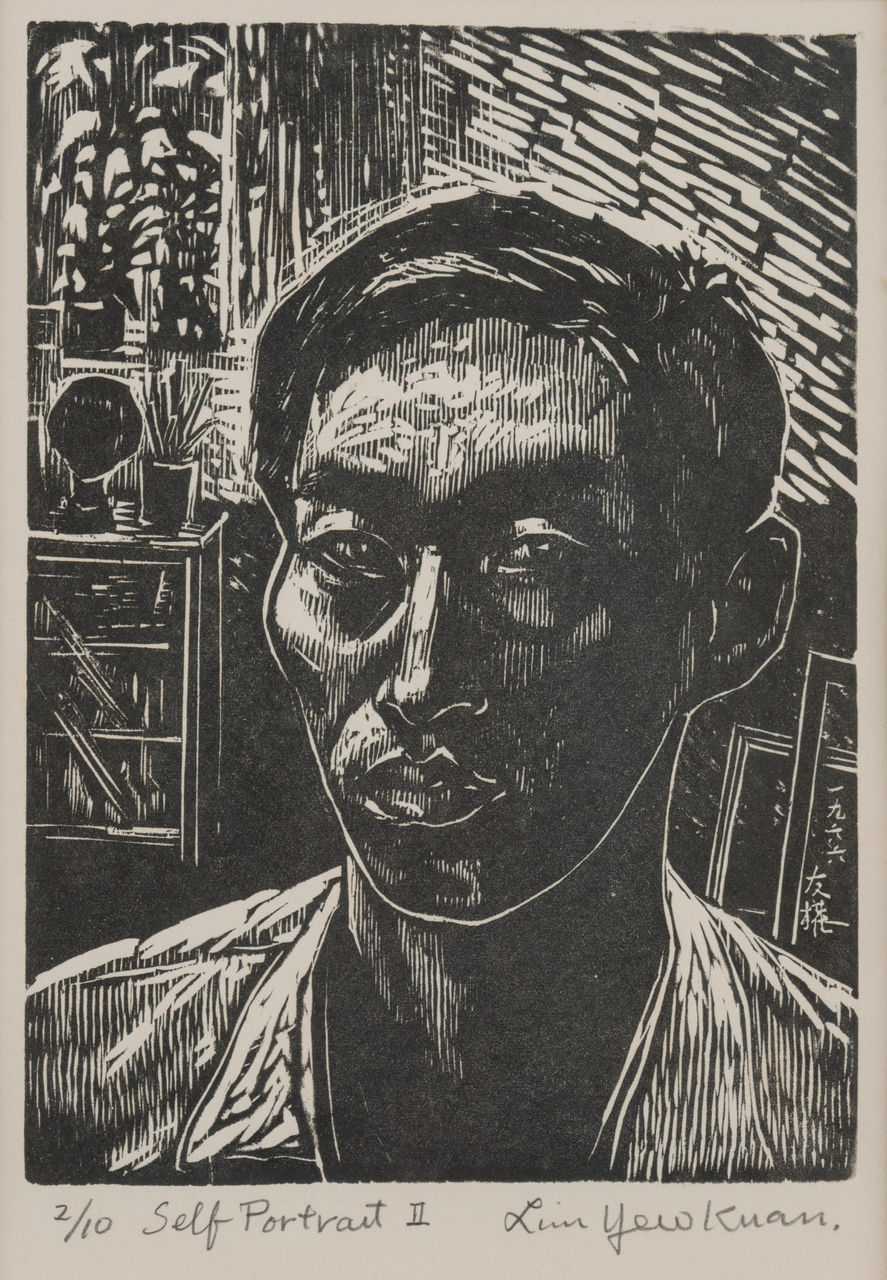
Lim Yew Kuan’s Self-Portrait II (fig. 6) print is pulled from a woodblock cut with deep incisions to depict the rugged individual essential to nation building.
Fig. 6. Lim Yew Kuan. Self-Portrait II. 1966. Woodblock print on paper, 20.5 × 15 cm.
The bookcase in the background alludes to the importance of education and self-improvement, calling for Singaporeans to constantly improve themselves to contribute to the overall progress of the country.
In addition, the Social Realist artists challenged the boundaries of self-portraiture. Choo Keng Kwang’s woodcut, 13th May Incident (fig. 7), depicts policemen, ordered by the colonial administration to use force to disperse Chinese middle school students who were protesting against the National Service Ordinance, which came into effect on 1 March 1954, as they perceived they were being forcibly conscripted to serve and protect the interest and order of the British colonial government that had discriminated against them in the past.
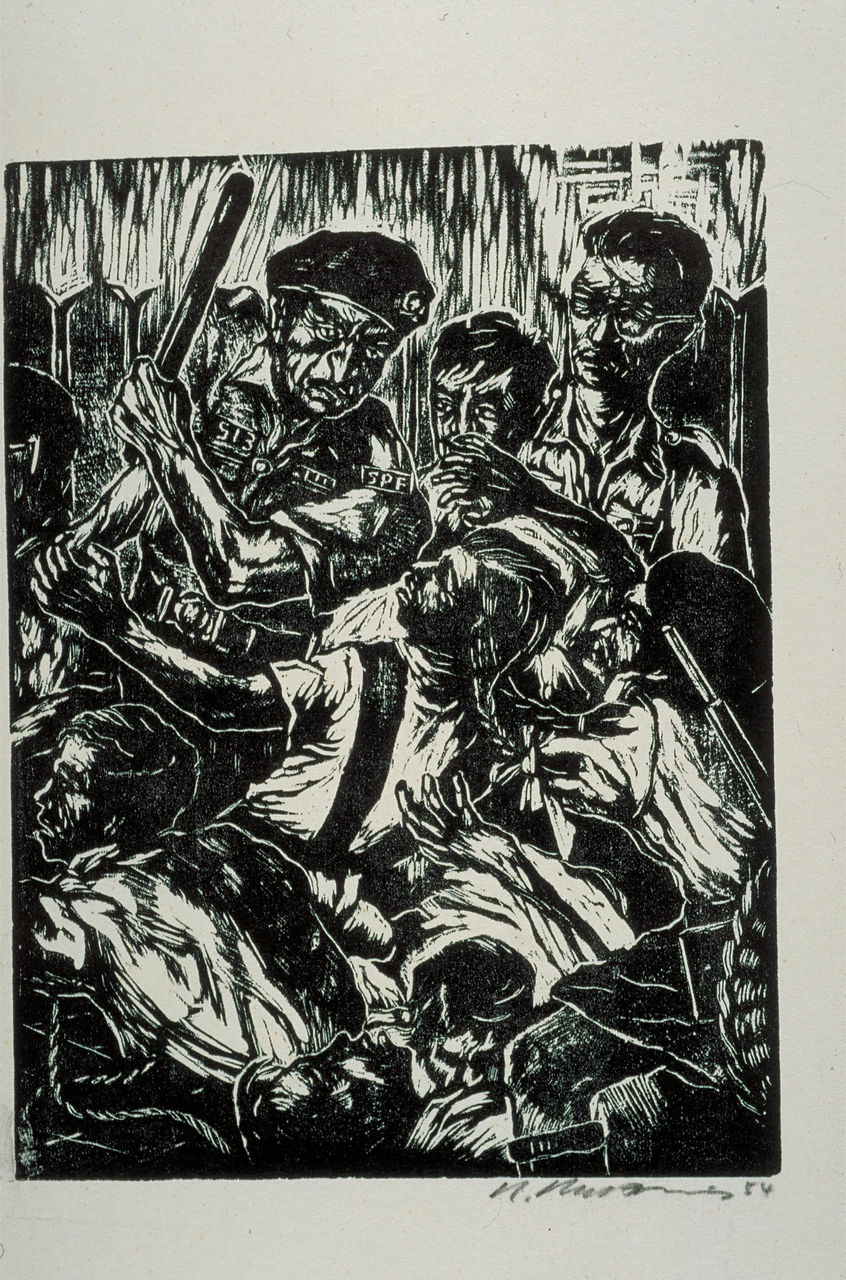
Choo Keng Kwang’s woodcut, 13th May Incident (fig. 7), depicts policemen, ordered by the colonial administration to use force to disperse Chinese middle school students who were protesting against the National Service Ordinance, which came into effect on 1 March 1954, as they perceived they were being forcibly conscripted to serve and protect the interest and order of the British colonial government that had discriminated against them in the past.
Fig. 7. Choo Keng Kwang. 13th May Incident. 1954. Woodblock print on paper, 20.5 × 15.5 cm.
Choo paints a likeness of himself into the scene as a witness to this historical event. The artist’s insertion of his likeness emphasises the agency of the individual as a critical witness to and actor in the country’s history. It can be interpreted as a gesture of resistance against the state’s calls for the individual to make sacrifices for the benefit of the British colonial government and creates ambiguities concerning the artist’s intention. Did he actually take part in the protest or was he a detached witness? What was his position on the police violence against the student protestors? Regardless of his intention, the artist’s insertion of his “self” into the event makes him a participant of it, whether real or imagined. These ambiguities in the work demonstrate how the primacy of the individual remains important in the production of multiple subjectivities that play a role in the construction of national narratives while remaining critical of it, thus opening up possibility for different interpretations.
Besides portraiture, landscape was also favoured by the Social Realist artists as it offered a way to represent the relationship between people and the land. Seascape (fig. 8) is the first woodcut collaboration between six artists namely: Choo Keng Kwang, Foo Chee San, Lim Mu Hue, Lim Yew Kuan, Tan Tee Chie and See Cheen Tee.
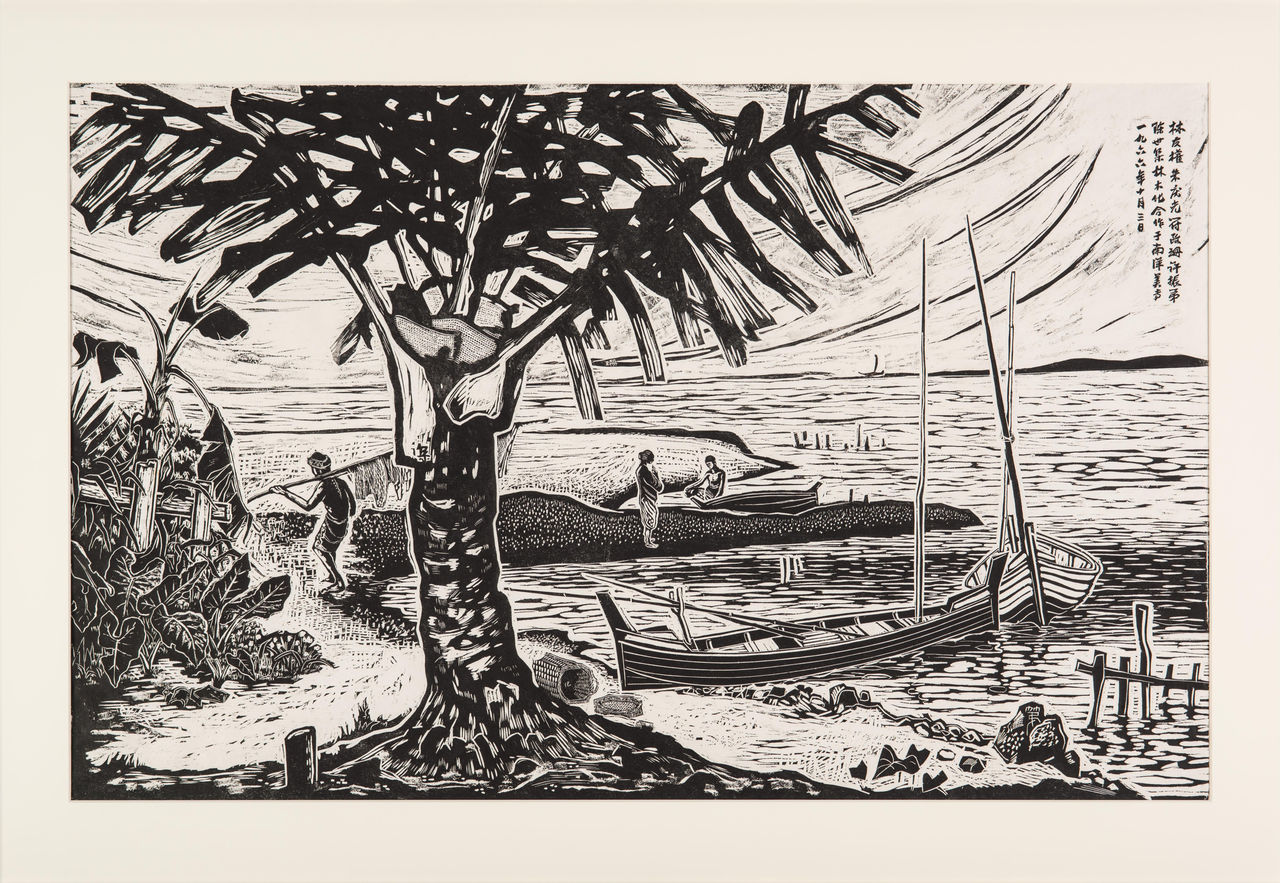
Seascape (fig. 8) is the first woodcut collaboration between six artists namely: Choo Keng Kwang, Foo Chee San, Lim Mu Hue, Lim Yew Kuan, Tan Tee Chie and See Cheen Tee.
Fig. 8. Choo Keng Kwang, Foo Chee San, Lim Mu Hue, Lim Yew Kuan, See Cheen Tee and Tan Tee Chie. Seascape. 1966. Woodblock print on paper, 77× 122 cm. Gift of 6-men woodcut artists, Choo Keng Kwang, Foo Chee San, Lim Mu Hue, Lim Yew Kuan, See Cheen Tee and Tan Tee Chie.
Each artist was given a section of the woodblock to work on and a single character from their names was carved into the different sections to identify the part that they had worked on. The result is a collaborative woodblock print that brings together different styles and techniques into a coherent composition of a Nanyang seascape. Besides its art historical significance as the first and only woodblock collaboration in Singapore, Seascape also demonstrates a mode of representing Singapore as an idyllic and picturesque island. Its narrative of peaceful tranquillity and stability is in contrast to the strive and resistance presented by woodcuts that engage with social and political issues.
In comparison to Seascape, the work After Fire (fig. 9) by Lim Yew Kuan adopts a different narrative that depicts the aftermath of a fire and the widespread devastation, on lives and the environment.
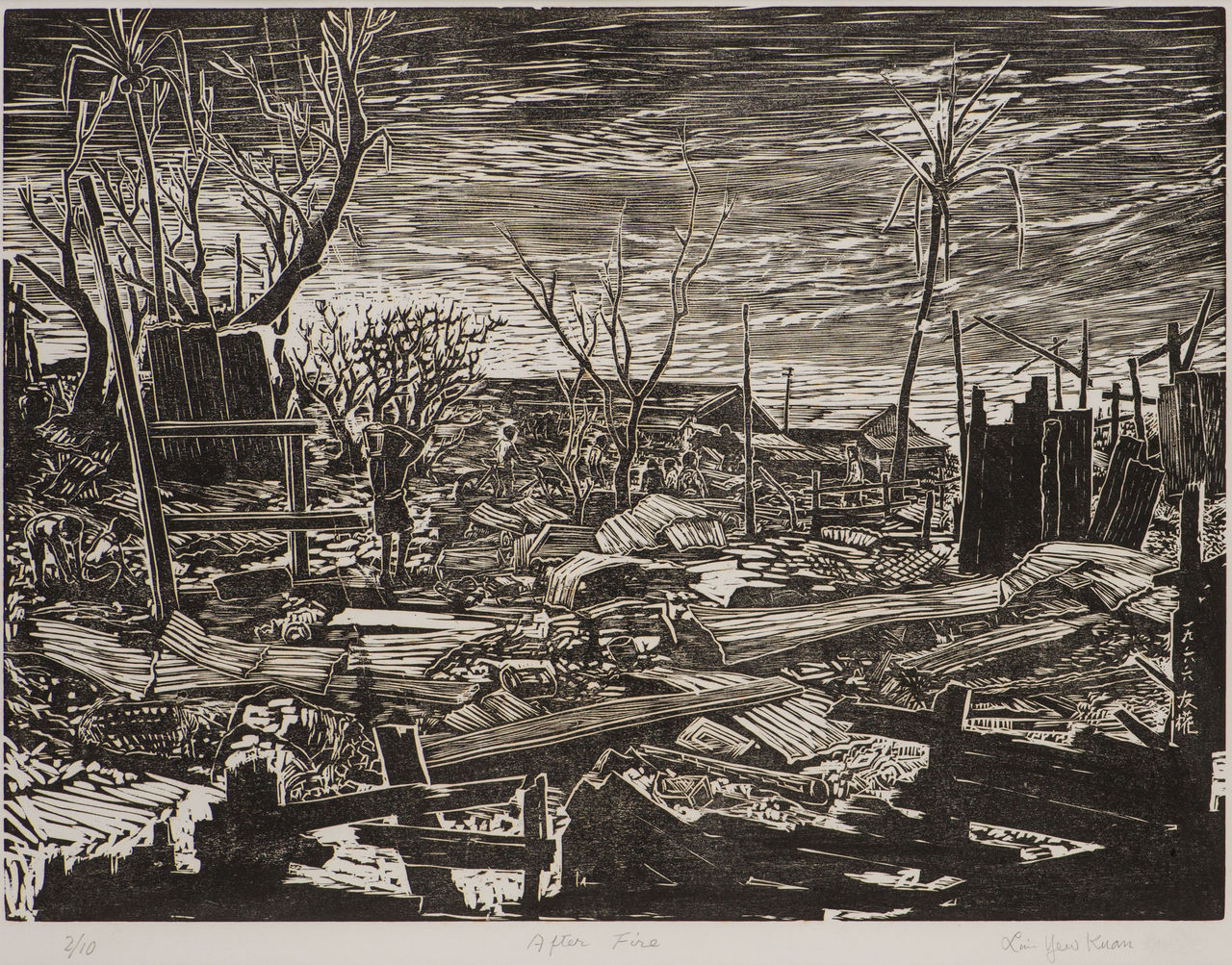
In comparison to Seascape, the work After Fire (fig. 9) by Lim Yew Kuan adopts a different narrative that depicts the aftermath of a fire and the widespread devastation, on lives and the environment.
Fig. 9. Lim Yew Kuan. After Fire. 1966. Woodblock print on paper, 45.5 × 61 cm.
The serenity of the seascape is replaced by destruction and loss. Fires were common in Singapore around estates such as, Tiong Bahru, Havelock Road and Bukit Ho Swee. One of the most serious of these fires occurred in Bukit Ho Swee on 25 May 1961, causing over 16,000 people to lose their homes made of attap and wood, which are particularly susceptible to fires. This eventually resulted in the replacement of attap houses with public housing equipped with better fire safety measures. The mode of representation in After Fire shifts from the Nanyang School, with its lyrical realism of the picturesque, to a stark and desolate image of a nation ravaged by destruction. Regardless of its mode of representation and narrative, this work shows how woodcut artists sought to develop their techniques through the use of fine or rough incisions into the woodblock, experiment with atmospheric effects to create depth and portray a diversity of subjects. The popularity of the woodcut movement hinged on its accessibility. Published widely in magazines and newspapers, cartoons reflect the changing social and political conditions of Singapore in the 1950s and 1960s, issues that were resonant with the public.
Section 05
Realism across the Boundaries of Medium
Realism is a dominant mode of representation in modern art that transcends boundaries between art societies and medium. Chen Chong Swee, who co-founded the Singapore Watercolour Society in 1969, was dedicated to realism throughout his career as an artist. For Chen, art had to be communicative, an idea which he expressed in a 1960 article:
Chen’s Market (fig. 10) which depicts a hive of activity in a site not just for economic but also cultural exchanges between people of different religion, ethnicity and class, exemplifies his commitment to depict the realities of everyday life.
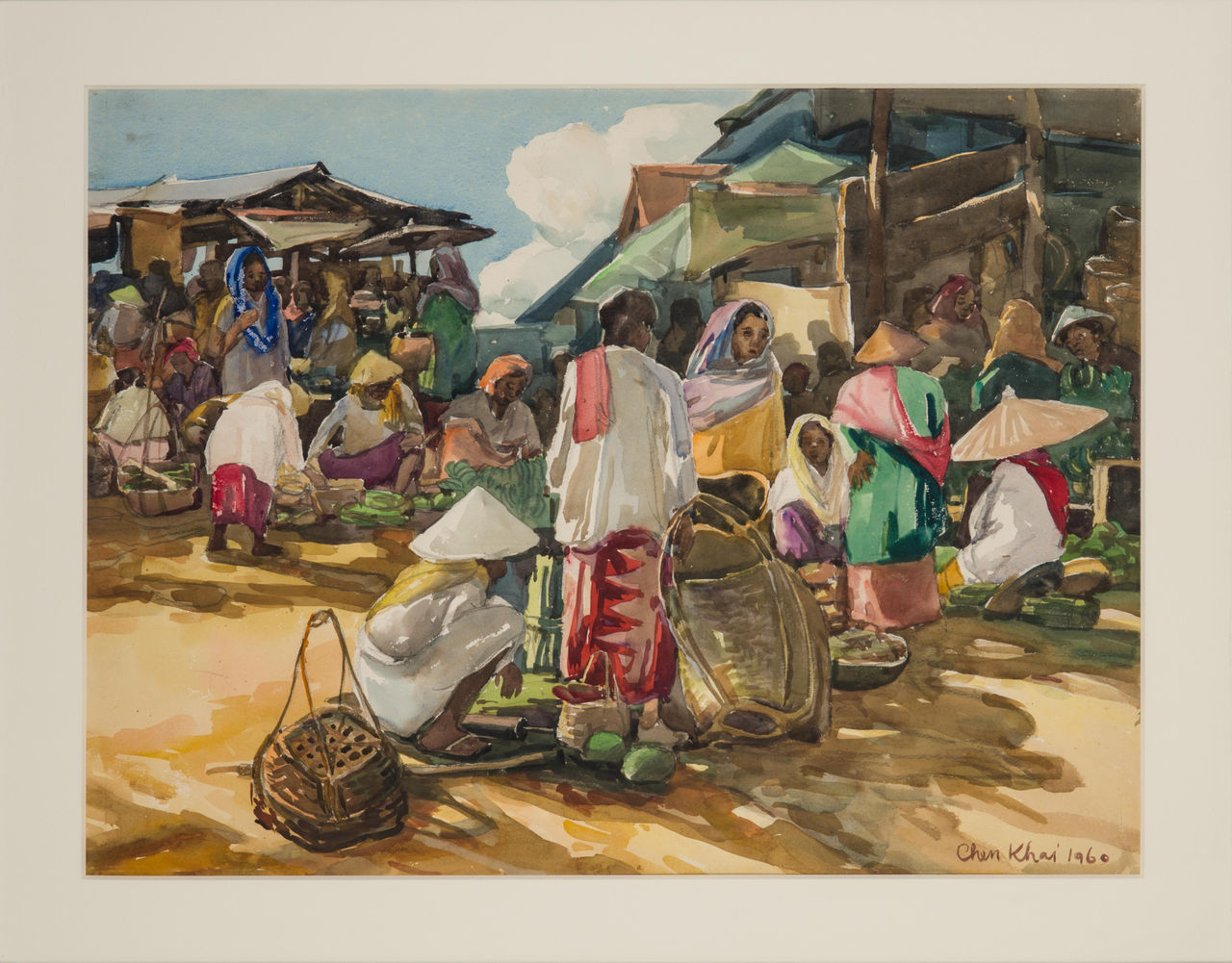
Chen’s Market (fig. 10) which depicts a hive of activity in a site not just for economic but also cultural exchanges between people of different religion, ethnicity and class, exemplifies his commitment to depict the realities of everyday life.
Fig. 10. Chen Chong Swee. Market. 1960. Watercolour on paper, 57.5 × 77. Gift of the family of the late artist.
Watercolour is a quick-drying medium which demands the artist to be spontaneous when painting. As such, watercolourists, such as Lim Cheng Hoe, would often paint outdoors to capture the immediacy and spontaneity of their subject. It is this immediacy that enables a watercolourist to “descend from the ivory tower” to actively engage with their subjects by being close to their sights, sounds and everyday lived experience that empowers their work to connect with viewers. In comparison to the hustle and bustle of Chen’s Market, Lim’s Singapore River (fig. 11) captures the quiet and tranquil atmosphere of the Singapore River with a row of bumboats moored by the side of the river from which modern buildings in the background seem to sprout. The humble bumboat as the economic engine that is powering Singapore towards modernity is given its place by Lim.
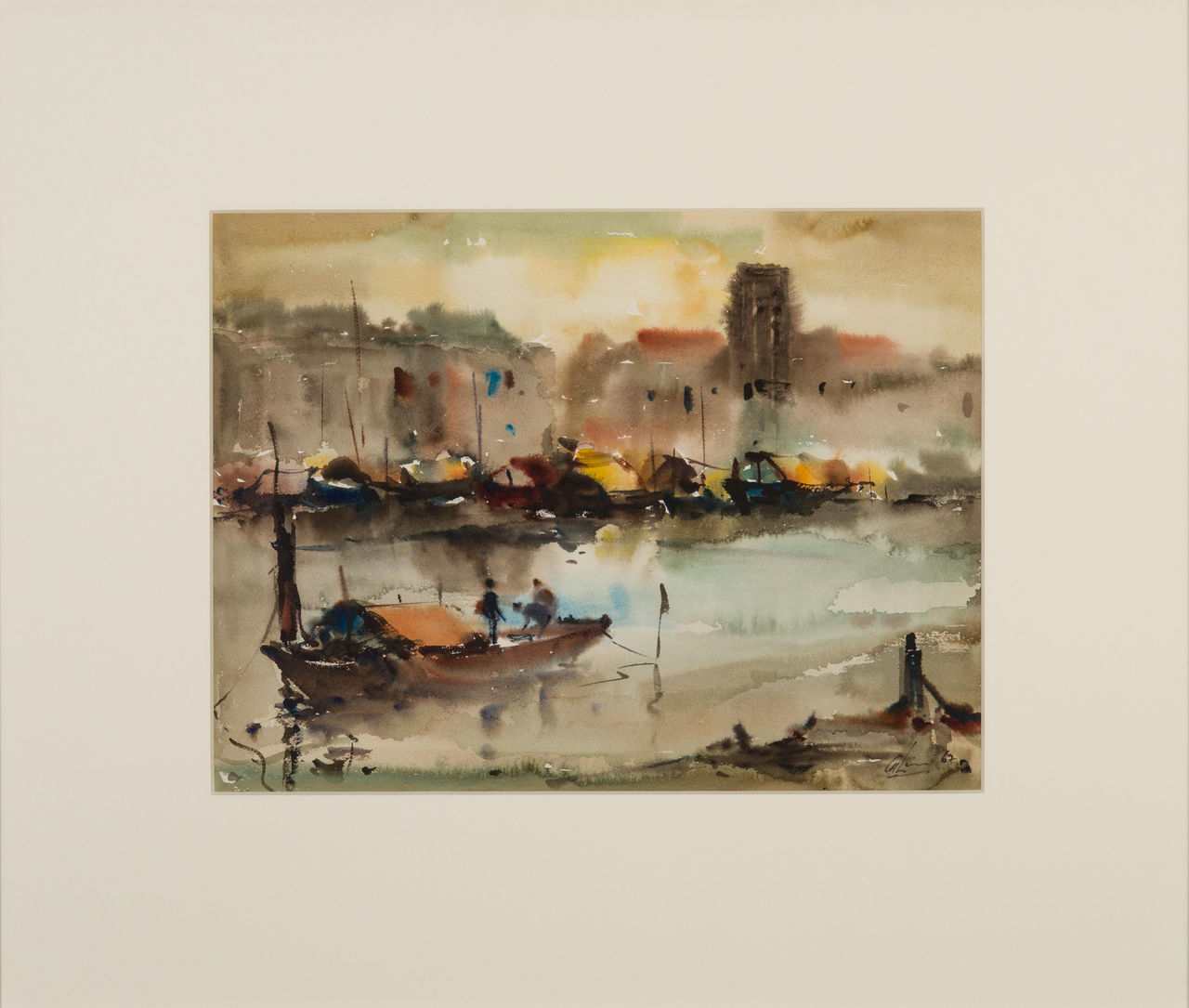
In comparison to the hustle and bustle of Chen’s Market, Lim’s Singapore River (fig. 11) captures the quiet and tranquil atmosphere of the Singapore River with a row of bumboats moored by the side of the river from which modern buildings in the background seem to sprout.
Fig. 11. Lim Cheng Hoe. Singapore River. Late 1960s. Watercolour on paper, 33 × 43 cm.
Section 06
New Language: Different Paths to Modernity
Modern art in Singapore is influenced by several sources. One source – Social Realism as advanced by the EAS – can be traced to the woodcut movement from China propagated by Lu Xun (1881–1936), as well as realist artists from Europe, such as, Gustave Courbet (1819–1877) and Auguste Rodin (1840–1917); and Russia, such as, Repin (1844–1930). Another source to modernity can be traced to the Nanyang artists who had looked towards the School of Paris and Chinese ink painting traditions to develop a new artistic language to represent subject matter unique to Singapore and Southeast Asia. This road to modernity, was spearheaded by the Nanyang artists, some of whom taught at NAFA and influenced students with their pictorial schemas and ideas. Chen Wen Hsi’s Washing (fig. 12 image not reproduced in the digital edition) is an example of early experimentations in developing new pictorial schemas to depict local subject matter. The work features a ubiquitous local scene of a person hanging clothes out to dry, painted in forms that are fragmented in a Cubist-style.
In Landscape (fig. 13), Cheong Soo Pieng experiments with oils and Chinese ink painting techniques to create ink-washed effects on canvas. These Nanyang artists’ formal experimentations with pictorial schemas, materials and techniques inspired the next generation of artists, many of whom were their students, to explore new visual languages.
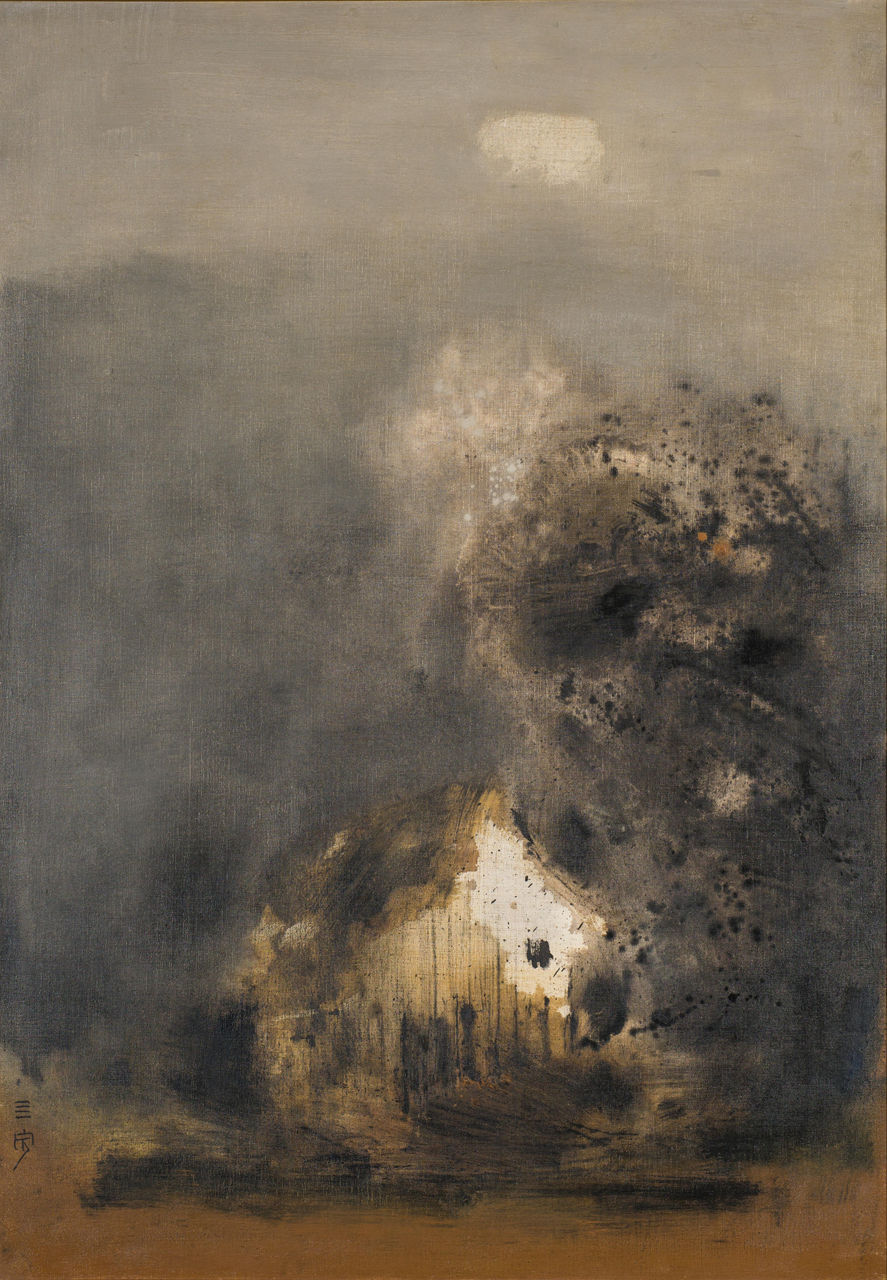
In Landscape (fig. 13), Cheong Soo Pieng experiments with oils and Chinese ink painting techniques to create ink-washed effects on canvas.
Fig. 13. Cheong Soo Pieng. Landscape. 1963. Oil on canvas, 101 × 70.6 cm.
Anthony Poon, a former student of Cheong Soo Pieng and Chen Wen Hsi, painted Jobless Son (fig. 14) soon after he graduated from NAFA in 1964.
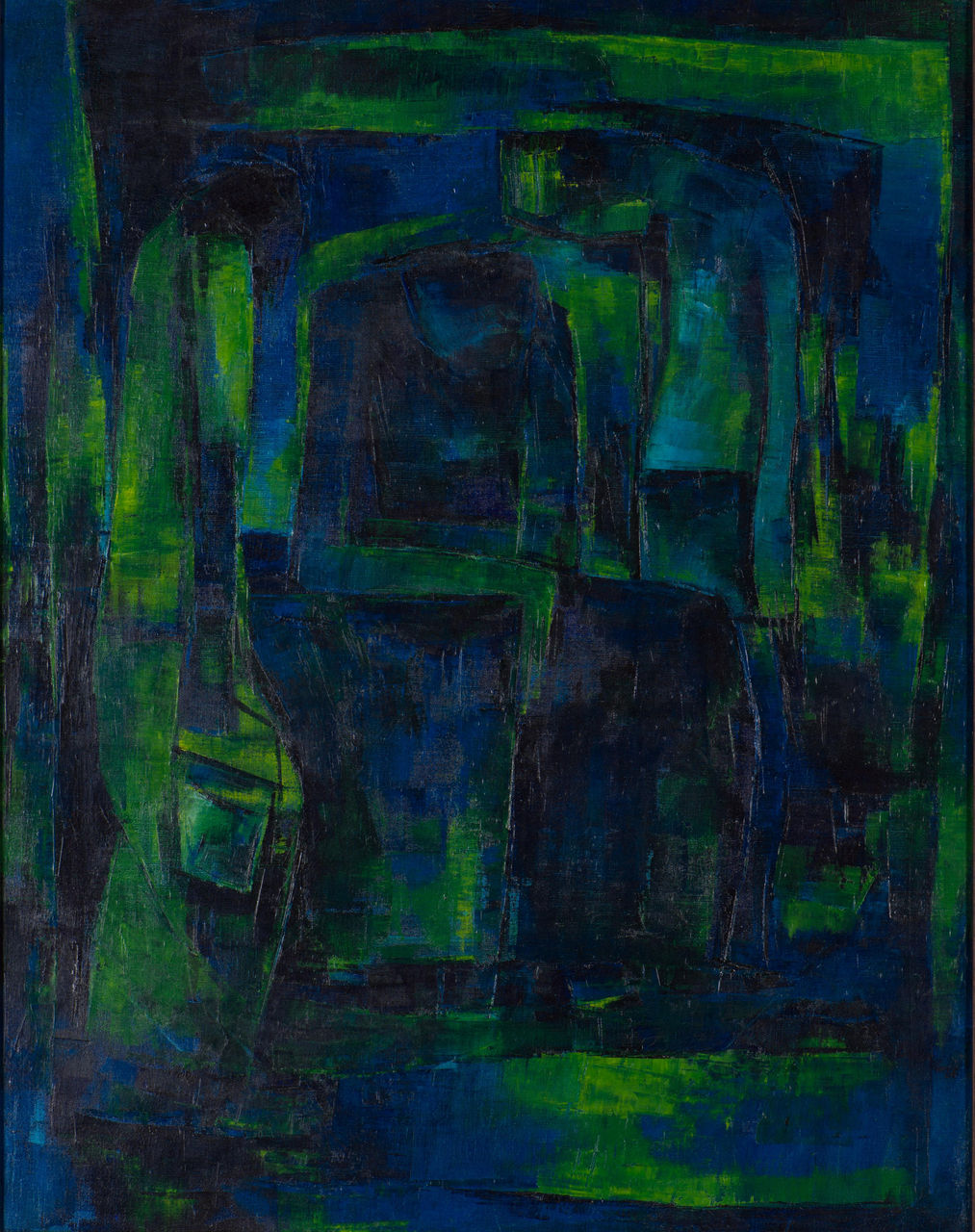
Anthony Poon, a former student of Cheong Soo Pieng and Chen Wen Hsi, painted Jobless Son (fig. 14) soon after he graduated from NAFA in 1964.
Fig. 14. Anthony Poon. Jobless Son. 1966. Oil on canvas, 93 × 74 cm.
In this work, the downcast figure is rendered in a Cubist form, similar to Chen’s Washing. Not all artists who experimented with these new pictorial schemas were graduates of NAFA. Ho Ho Ying studied art under Liu Kang and Chen Wen Hsi when he was a student at the Chinese High School. He later graduated from Nanyang University with a bachelor’s degree in Chinese Language and Literature in 1962. He also studied art books and was influenced by Abstract Expressionism, in particular, Jackson Pollock’s drip paintings. Ho also closely followed the abstract and Surrealist movements in Taiwan, such as the Fifth Moon Group, which was active in the 1960s. In Rhythm of Dance (fig. 15), Ho’s fluid and swift brushstrokes capture the energetic movement and spontaneity of dancers.
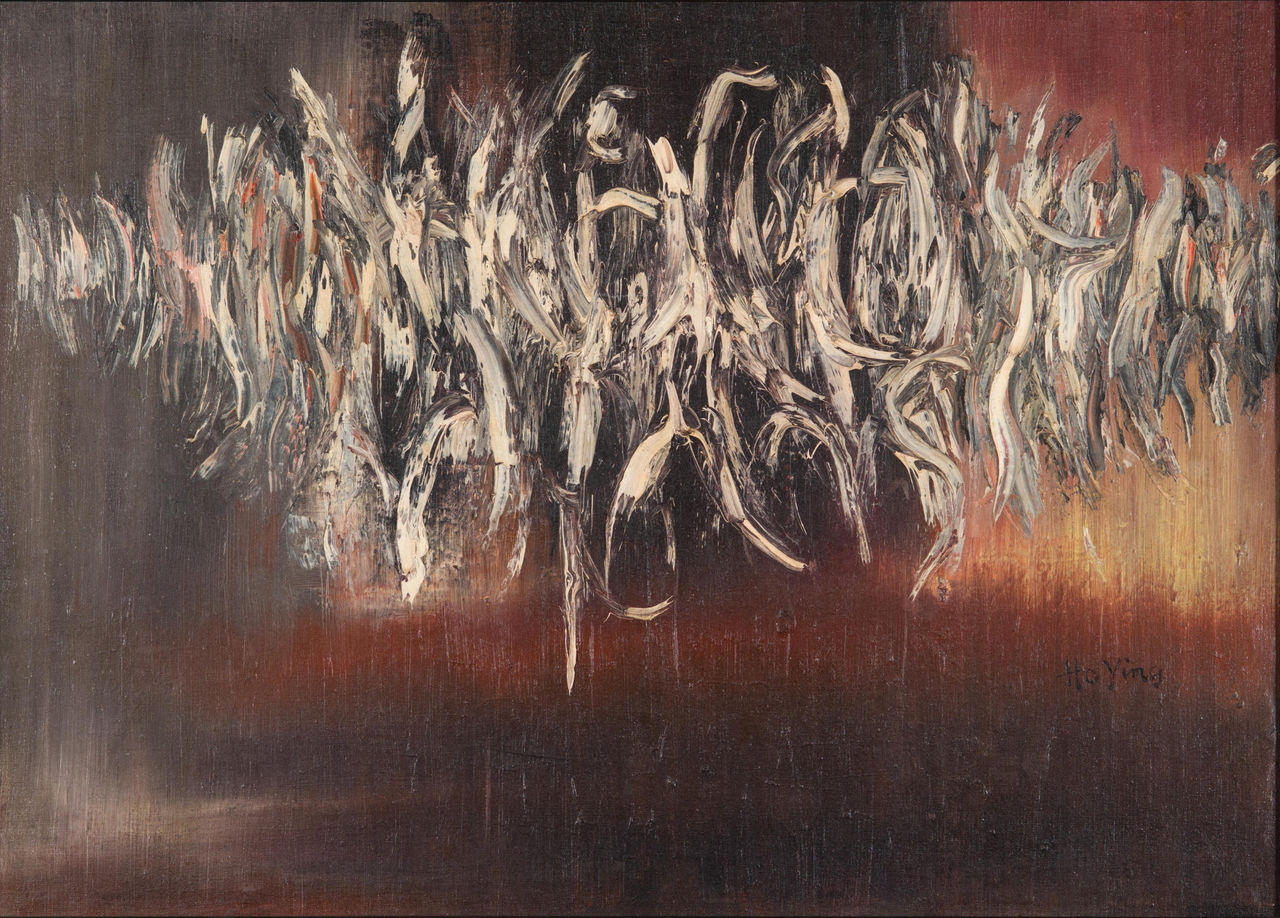
In Rhythm of Dance (fig. 15), Ho’s fluid and swift brushstrokes capture the energetic movement and spontaneity of dancers.
Fig. 15. Ho Ho Ying. Rhythm of Dance. 1959. Oil on canvas, 58 × 82 cm.
The work is an early example of his experimentation with Abstract Expressionism based on his own Taoist philosophy of letting one’s imagination be free without boundaries.17
The younger generation of artists in Singapore furthered their art education abroad and developed new visual languages while overseas, which they brought with them when they returned to Singapore. Anthony Poon studied at the Byam Shaw School of Art in London (1967–1970) followed by the Regional College of the Arts in Bradford, United Kingdom (1970–1971). His explorations into pure geometric forms depart from his early cubist figurations created while studying at NAFA. In Black and White (fig. 16), the interplay between squares outlined in silver against a black background is reminiscent of Op Art and the hard-edge style of painting – modernist references that Poon would have been exposed to in London.
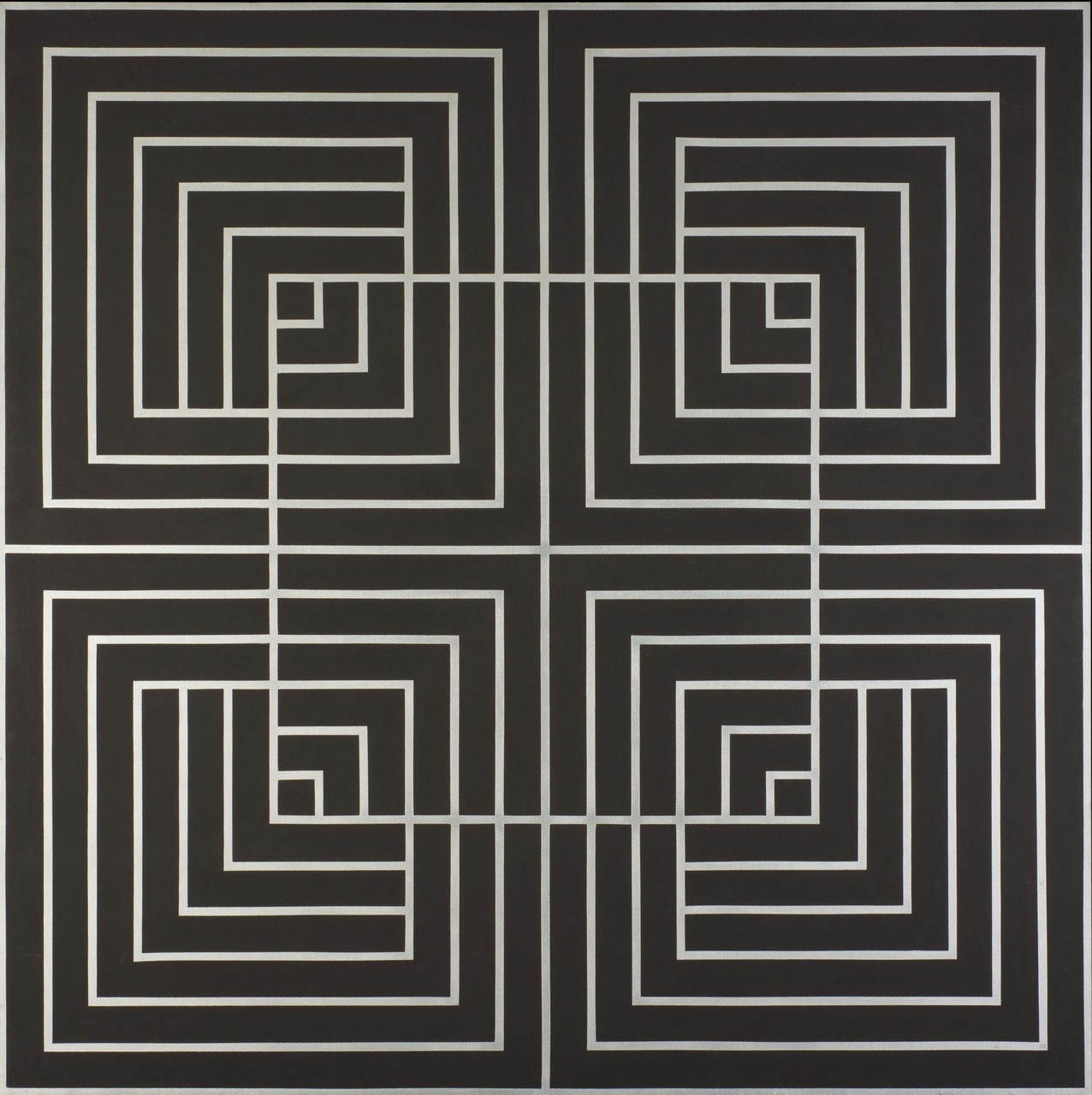
In Black and White (fig. 16), the interplay between squares outlined in silver against a black background is reminiscent of Op Art and the hard-edge style of painting – modernist references that Poon would have been exposed to in London.
Fig. 16. Anthony Poon. Black and White. 1970s. Acrylic on canvas, 186 × 186 cm.
In 1962, Goh Beng Kwan left to study at the Art Students League of New York. When he was in New York, Goh encountered works by the American Expressionists and felt that their spontaneous brushwork painted in an intuitive manner had synergies with the xieyi style of Chinese ink painting. Black Afternoon (fig. 17) is an early example of Goh’s use of Chinese calligraphic lines to create a sense of space as well as spontaneous drips and splashes of paint to enliven the painting.
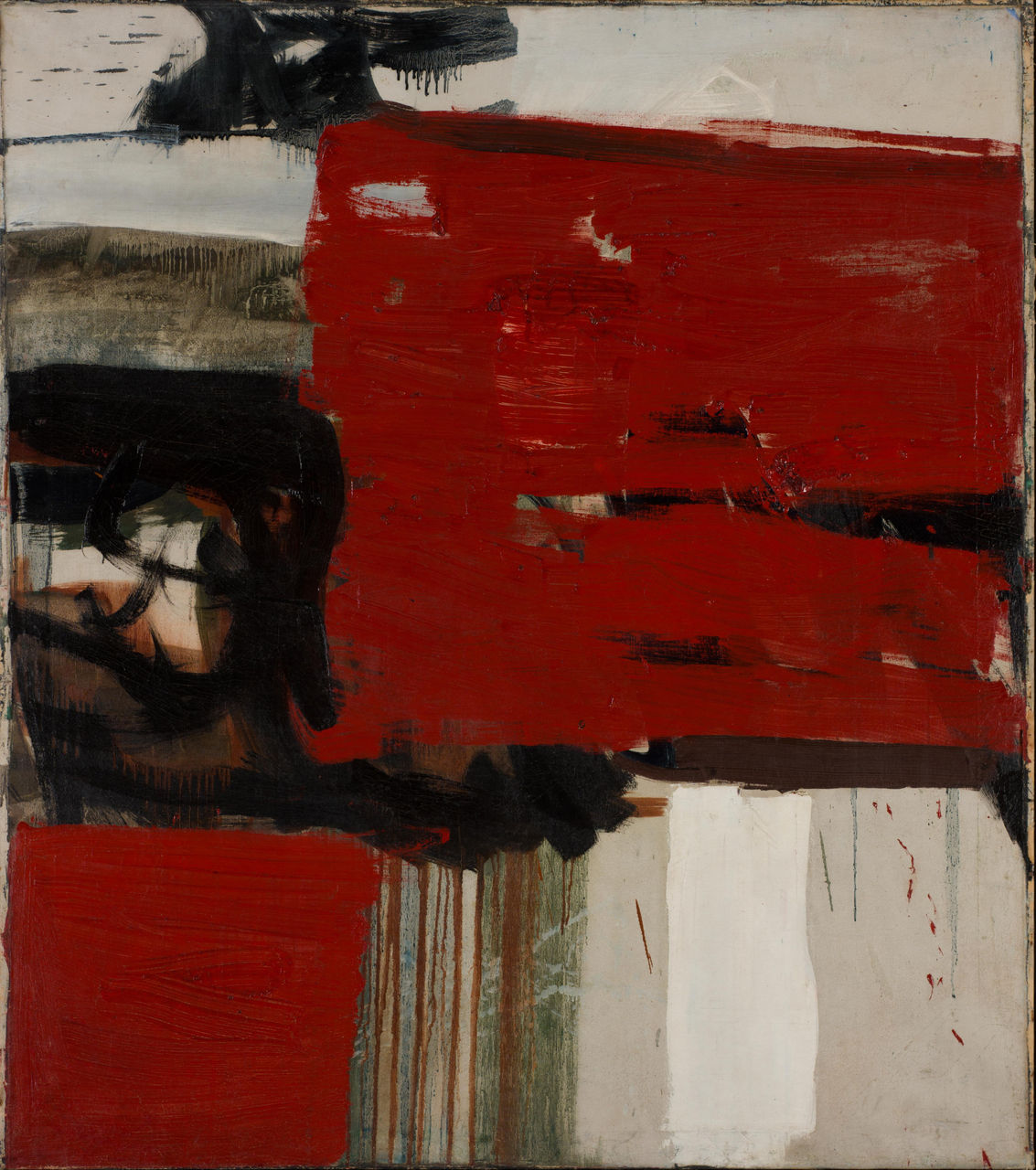
Black Afternoon (fig. 17) is an early example of Goh’s use of Chinese calligraphic lines to create a sense of space as well as spontaneous drips and splashes of paint to enliven the painting.
Fig. 17. Goh Beng Kwan. Black Afternoon. 1963. Mixed media on canvas. © Goh Beng Kwan.
Artists who studied abroad and those who stayed in Singapore continued to experiment with new visual languages. Those artists who developed their practices in Singapore continued to engage with Internationalism – defined as the proliferation of art movements and styles, such as abstraction and Abstract Expressionism, that advanced universal aesthetics and ideologies globally. Jaafar Latiff’s Wandering Series (fig. 18) features batik techniques using industrial dyes, instead of traditional dyes, to create organic shapes rendered in expressive colours that slip between stable and dynamic structural forms. Batik was also explored by Sarkasi Said in Fish (fig. 19) to create wave-like patterns and fin-shaped forms that suggest the energy and agility of fishes swimming in the sea. The evocative movement and vigour of the works by Jaafar Latiff and Sarkasi Said contrast with Abdul Ghani Hamid’s quiet piece, The Face in Meditation (fig. 20).
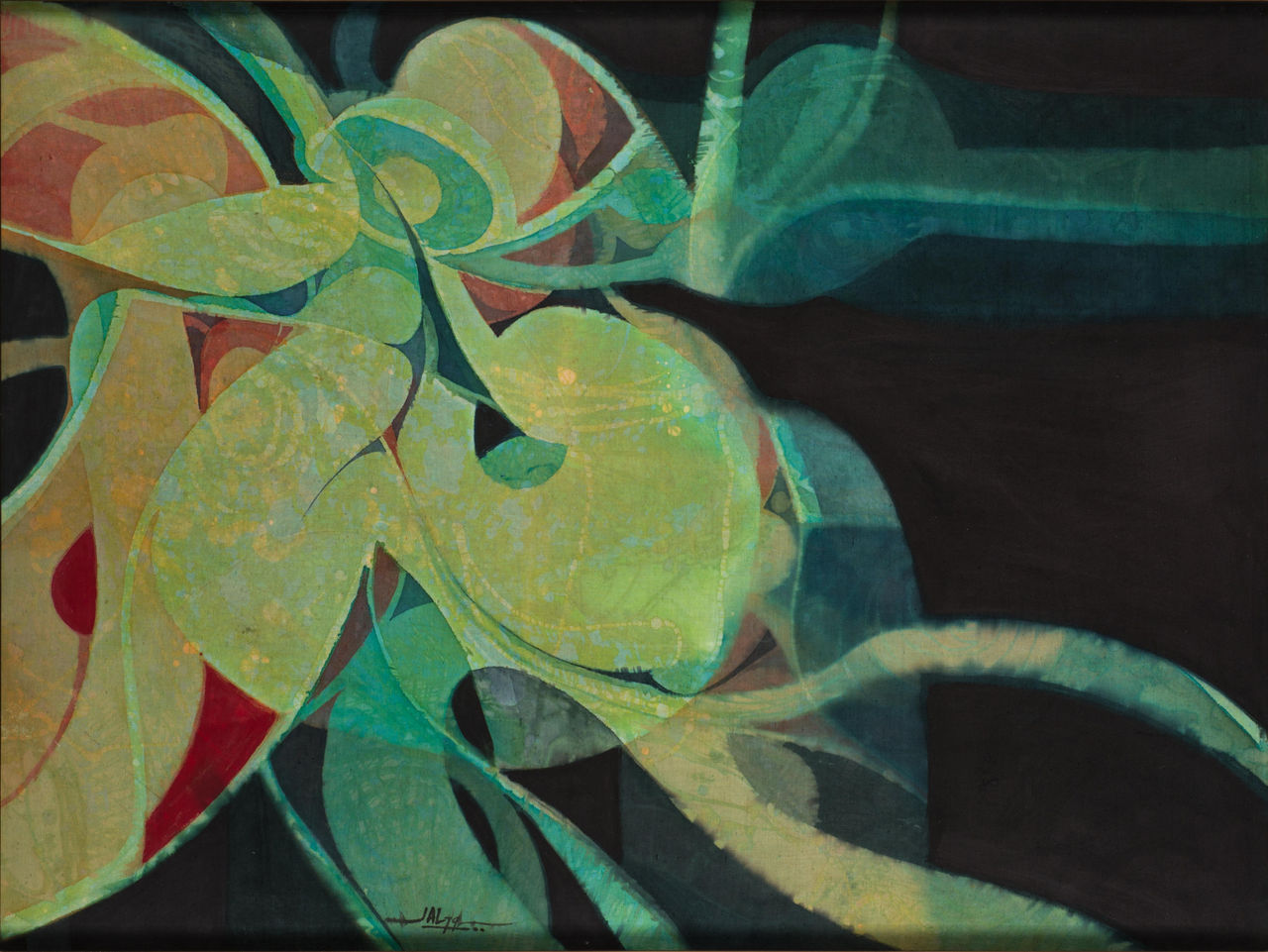
Jaafar Latiff’s Wandering Series (fig. 18) features batik techniques using industrial dyes, instead of traditional dyes, to create organic shapes rendered in expressive colours that slip between stable and dynamic structural forms.
Fig. 18. Jaafar Latiff. Wandering Series. 1976. Batik, 100 × 100 cm. Gift of the artist.
1 3
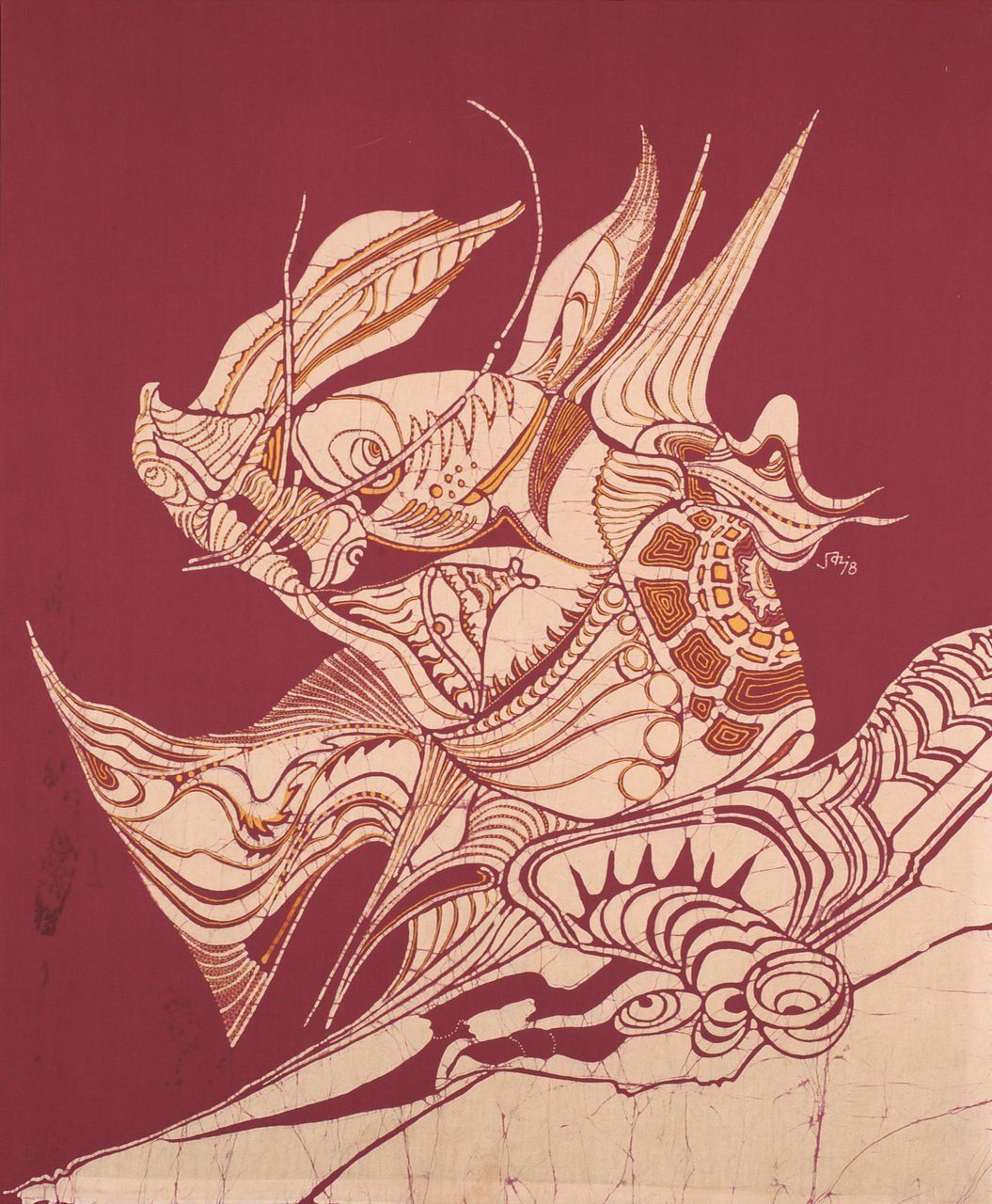
Batik was also explored by Sarkasi Said in Fish (fig. 19) to create wave-like patterns and fin-shaped forms that suggest the energy and agility of fishes swimming in the sea.
Fig. 19. Sarkasi Said Tzee. Fish. 1978. Batik, 101 × 83 cm.
2 3
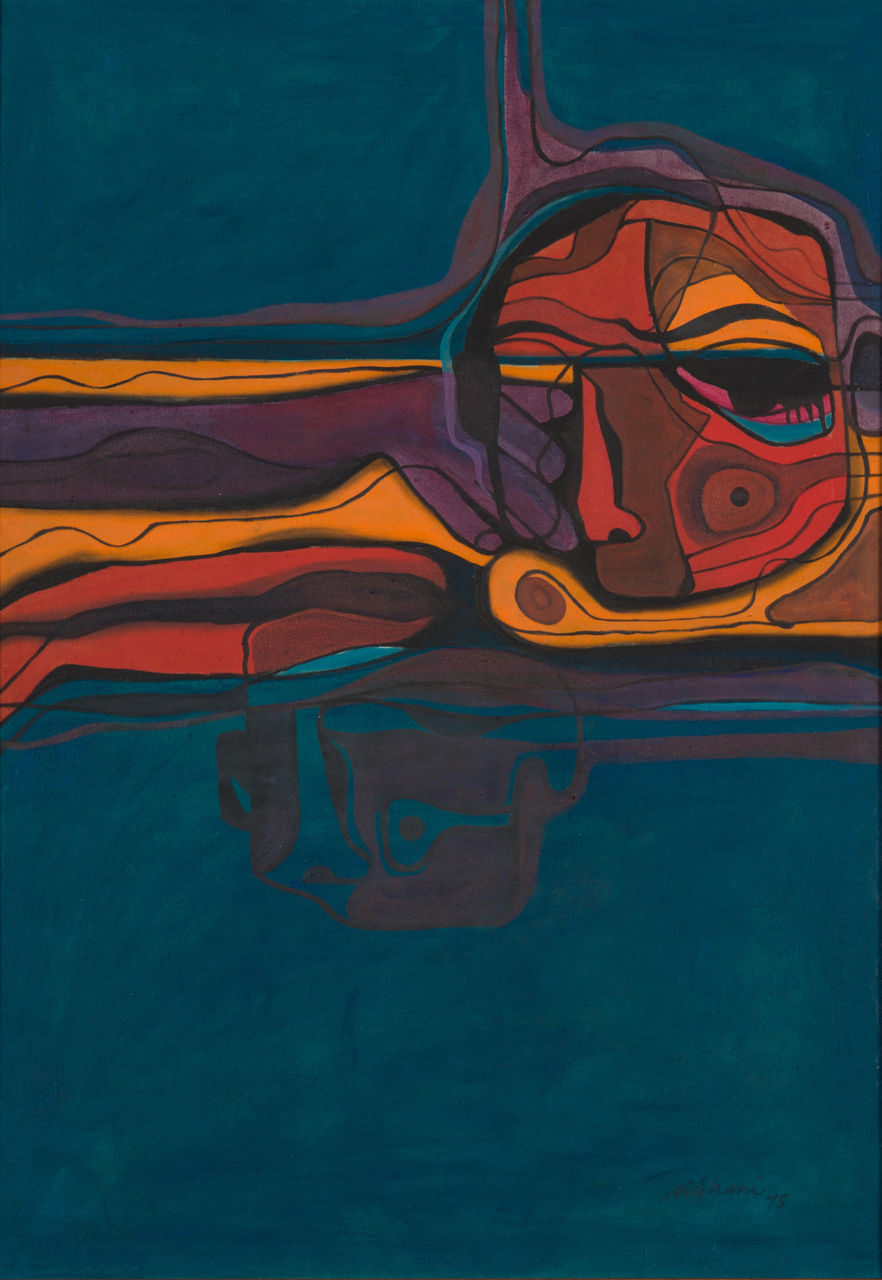
The evocative movement and vigour of the works by Jaafar Latiff and Sarkasi Said contrast with Abdul Ghani Hamid’s quiet piece, The Face in Meditation (fig. 20).
Fig. 20. Abdul Ghami Hamid. The Face in Mediation. 1975. Oil on canvas, 86 × 61 cm. Gift of the artist.
3 3
In The Face, rhythmic lines evoke a sense of harmony and tranquillity. These three Malay artists, instrumental in their engagement with traditional motifs, techniques and abstraction, were also part of Angkatan Pelukis Aneka Daya (Association Artists of Various Resources), a local Malay artist association that was formed in 1962. Like Sarkasi Said, Tay Chee Toh turns towards the sea for inspiration for his organic forms. In Golden Shadow (fig. 21), he uses wave-like forms and splashes of black acrylic paint on canvas that resemble the effect of ink spreading spontaneously on paper to create the atmosphere at the beach. While Tay’s works excite our senses with his amorphous forms and tropical colours, Chng Seok Tin’s Social Climbers (fig. 22) depict shadowy figures that appear to relentlessly climb ropes set in a cityscape as a critique of our single-minded obsession to satisfy our material desires and to succeed in life.
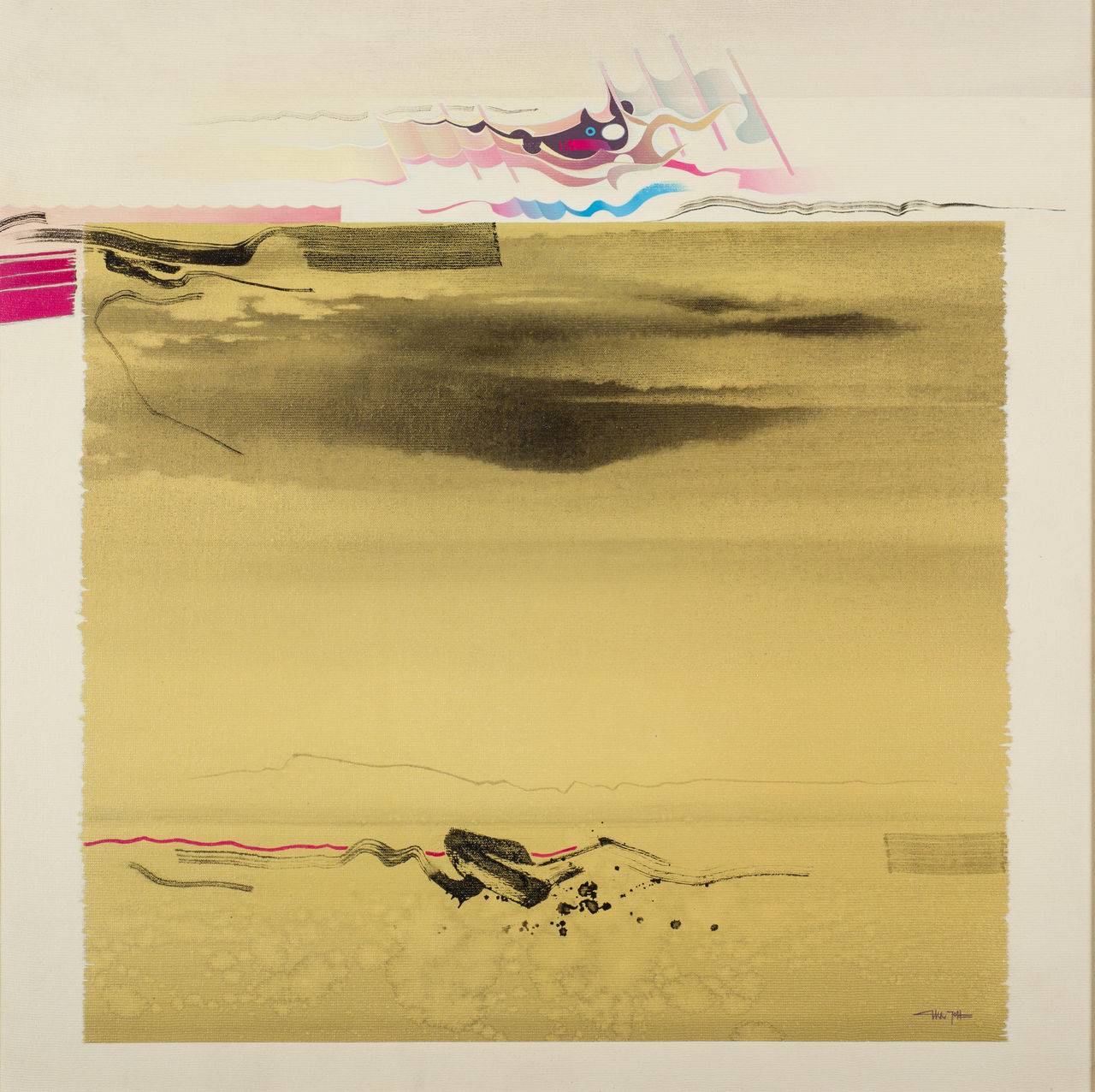
Fig. 21. Tay Chee Toh. Golden Shadow. 1985. Acrylic on canvas, 122 × 122 cm.
In Golden Shadow (fig. 21), he uses wave-like forms and splashes of black acrylic paint on canvas that resemble the effect of ink spreading spontaneously on paper to create the atmosphere at the beach.
1 2
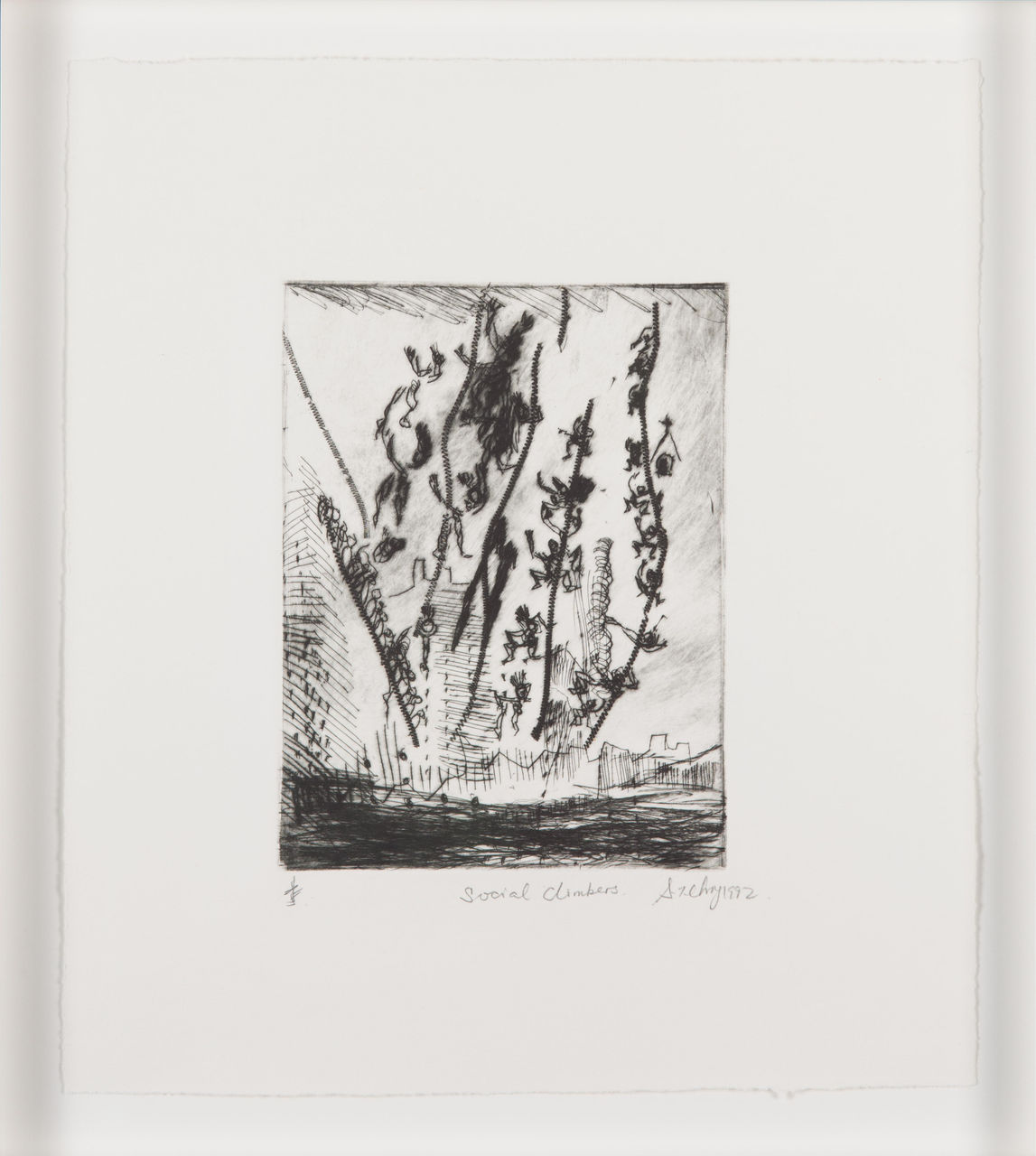
While Tay’s works excite our senses with his amorphous forms and tropical colours, Chng Seok Tin’s Social Climbers (fig. 22) depict shadowy figures that appear to relentlessly climb ropes set in a cityscape as a critique of our single-minded obsession to satisfy our material desires and to succeed in life.
Fig. 22. Chng Seok Tin. Social Climbers. 1992. Drypoint on paper, 25 × 19 cm. Collection of Singapore Art Museum.
2 2
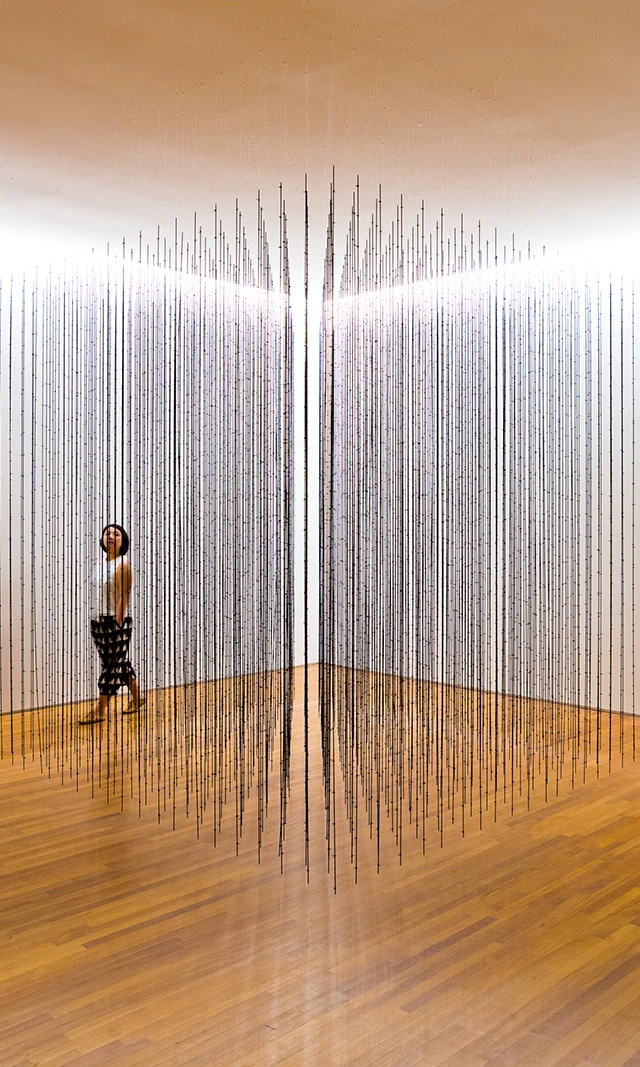
Experimentations in abstraction were also seen in sculpture. Kim Lim’s Echoes (fig. 23) is a U-shaped form that reflects sound to produce an echo. Tan Teng Kee’s Space Sculpture Number 1 (fig. 24) breaks into space with a multitude of protruding lines from different directions creating multiple perspectives.
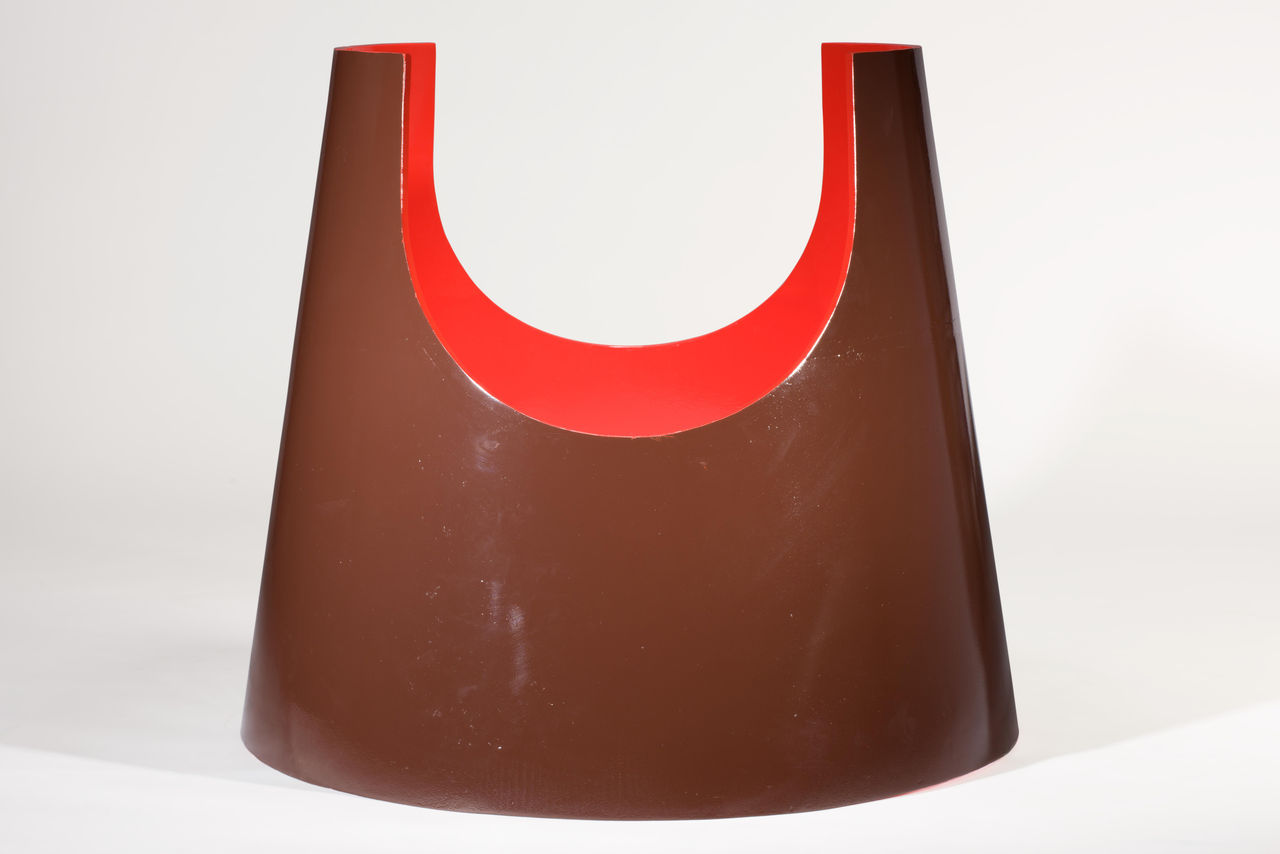
Kim Lim’s Echoes (fig. 23) is a U-shaped form that reflects sound to produce an echo.
Fig. 23. Kim Lim. Echoes. 1967. Stainless steel, enamel paint and zinc coating, 77 × 80 × 80 cm. Gift of William Turnbull.
1 2
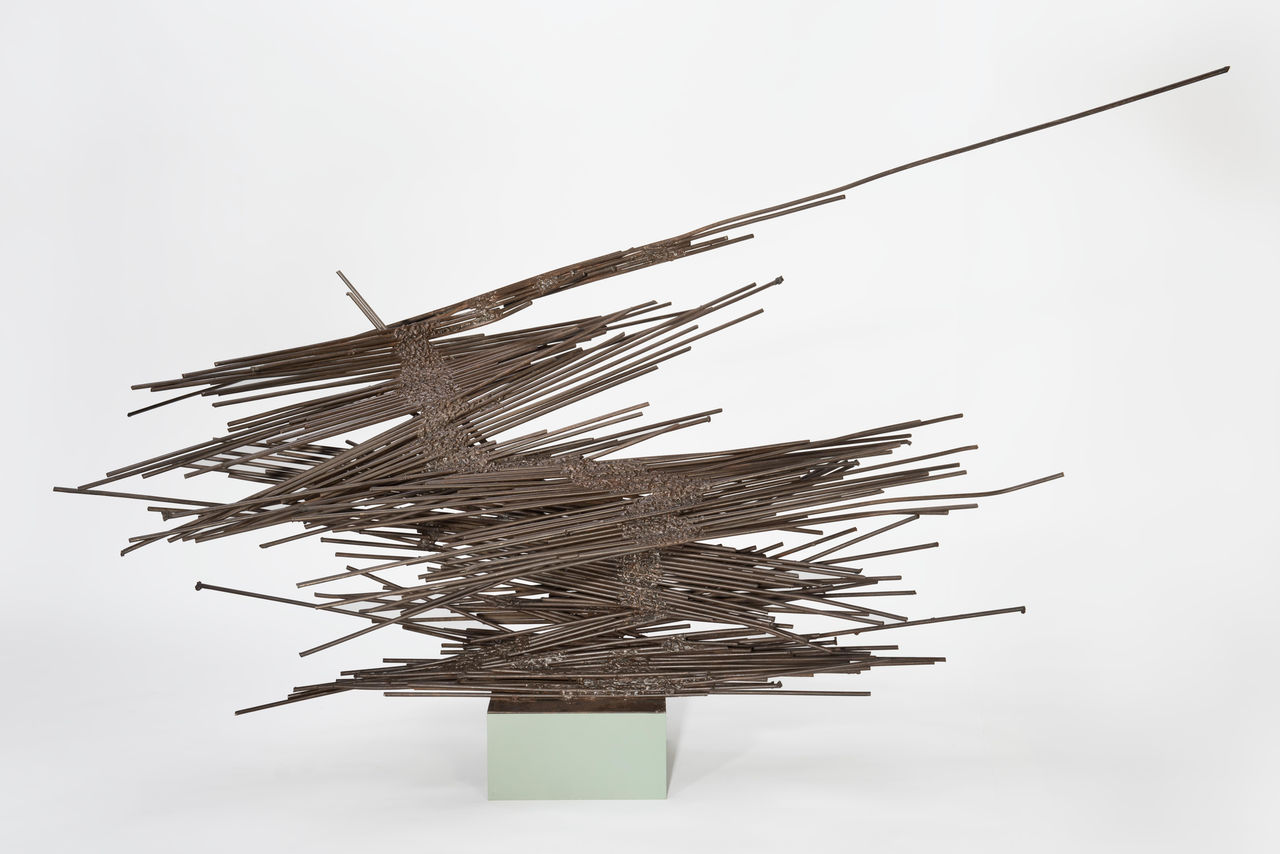
Tan Teng Kee’s Space Sculpture Number 1 (fig. 24) breaks into space with a multitude of protruding lines from different directions creating multiple perspectives.
Fig. 24. Tan Teng Kee. Space Sculpture No. 1. 1976. Metal, 107 × 228 (widest length) × 123. Gift of the artist.
2 2
Perspective remained an important area of study by sculptors who adopted abstraction as their visual language. When viewed from different angles, Advance (fig. 25) by Anthony Poon shows the potential of flight as its wing-like forms appear to propel the sculpture forward.
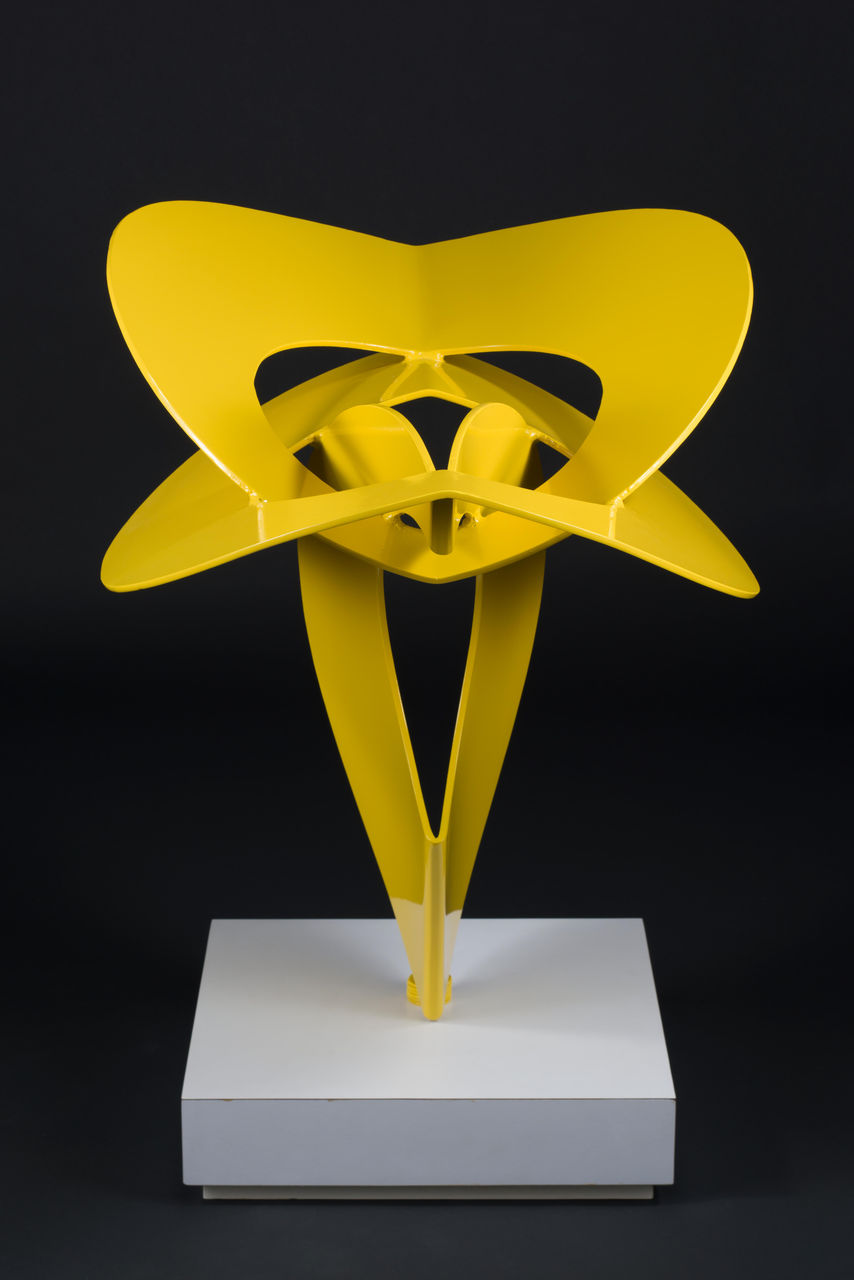
When viewed from different angles, Advance (fig. 25) by Anthony Poon shows the potential of flight as its wing-like forms appear to propel the sculpture forward.
Fig. 25. Anthony Poon. Advance. 1991. Painted steel, 76.5 × 52.5 × 72.5 cm. Collection of Singapore Art Museum.
When Poon returned to Singapore in 1971, he joined the Alpha Gallery as a manager from 1973-78, taking over from Khoo Sui Hoe. The Alpha Gallery was founded by Datuk Lim Chong Keat to feature local modernist artists who experimented in abstraction and formalism such as Thomas Yeo, Quek Wee Chee, Teo Eng Seng, Arthur Yap and Eng Tow. Although new visual languages, such as abstraction, gained traction from the 1960s, it faced competition from its detractors, particularly the realist artists entrenched in the “real.”
Section 07
The Great Debate: The Real and the New
The 1950s and 1960s were decades “when ideas did matter, when hearts and minds had to be won, when spirits had to be steeled and the legitimacy of the new state established. It was a time when ideas did have the force of acts.” 18 The 1950s were particularly turbulent years, when violent strikes and riots by mostly students from the Chinese Middle Schools and Trade Unions, believed to have been instigated by the communists, were rampant. For instance, demonstrations by Chinese students against the National Service Ordinance in 1954, followed by the Hock Lee bus strikes in 1955, resulted in injuries and death. The ideological challenge mounted by the communists was not contained within the political sphere. Competing ideologies, a product of the Cold War, were also manifested in the sphere of cultural production through the proclamation of art manifestos.
What is an art manifesto? It is a rhetorical device, issued by an art group or collective of artists, posturing as militants as a result of their association with the “avant garde,” to an audience with the intention to shock, propagandise, revolutionise, and thus subvert entrenched ideas, aesthetics and systems.19 Art manifestos are a perennial occurrence in the history of Western modernism. Art collectives such as the Futurists, Dadaists, Surrealists, Situationists, and Fluxus group, issued manifestos as public declarations of their artistic ideas and intentions. Art manifestos can be considered as literary works as they present ideas in a textual form in a social context that operate at the intersection of art and society. This relationship between the art manifesto and society can be traced to its historical relationship with its predecessor, the political manifesto. Political manifestos are ideological documents issued by various collective agents, and even individuals, who have political statements to make with the intention of changing society. Art manifestos may also carry political statements and be aligned with the agenda of political groups.20
Art manifestos published in Singapore during the 1950s reveal emerging tensions between realism and new pictorial schemas, such as Cubism. Lee Tian Meng’s “Three Reasons against the Ideas of Pablo Picasso” published in an exhibition catalogue in 1956, can be seen as an art manifesto that was issued in the name of the SCMSGAA. Lee claims:
Lee couches his essay in both stylistic and political terms. Cubism is cast as anti-humanistic, false and violent as opposed to the harmony and truth that realism upholds. Artistic styles are proposed as indices of worldviews and Cubism is denounced accordingly as an exemplification of the “decadent culture” of the West that will threaten the social and political fabric of Malaya.22 Realism is held as the only “true” art while Cubism is demonised. Lee’s declaration qualifies as a manifesto not only in its rhetorical tone but also its privileging of an aesthetic ideal (Realism), while condemning another (Cubism). Art (or in this case, Realism) was declared political.
The Modern Art Society (MAS) burst on to the Singapore art world in 1963 with their first exhibition, anointing itself as the harbinger of the “new.” But what aesthetic ideal did the MAS champion as the “new”? The foreword to the exhibition catalogue published in 1969 explains: “the main concerns of modern artists are the beauty of form, harmony of rhythm and creativity.” 23 “Art is to be found in living lines, breathing strokes, unique structures, or moving colours.” 24 “Beauty” could be interpreted as the arrangement and composition of the elements of form (space, rhythm, harmony, line and colours).25 While form was advanced as the society’s aesthetic ideal, “ideas [were] only of subsidiary importance.” 26 Not only was form privileged over ideas, “[art] does not have to be concerned with reality, alikeness, meaning, or the worldly view of beauty.” 27 In a bold statement extolling form as the pre-eminent criterion in art: “We [the MAS] appreciate them [artworks] as long as they are composed and arranged artistically.” 28 MAS also proposed form as a universal language of art, as its elements such as colour, shape, and line, need not carry culturally specific meanings. Modern art could be created by “instinctual impulses” that draw from the experiential and intuitive as productive sources.29 With its proclaimed universality, “Modern art is therefore an effective and essential means to promote better understanding amongst the various countries of the world.” 30 Although the MAS was the first to propel the new visual language, abstraction, as modern, early experimentations in abstraction in Singapore can be traced to the Nanyang artists. For example, Cheong Soo Pieng’s Energy (fig. 26 image not reproduced in the digital edition) captures the energy exuding from a landscape nourished by the sun. In spite of these early forays into abstraction, it was the MAS who galvanised the idea of a new formalist visual language in accord with “the modern” through manifestos and thus set in motion a new art movement that searched relentlessly for the new that expanded beyond specific styles (such as abstraction) into alternative ways of making and thinking about art.
Section 08
Conclusion: Different Modes of Representing the Real and the New
Contestation between the modes of representation – Realism (art that is socially engaged, communicative, and humanist in its evocation of empathy in people) and Abstraction (art that seeks for a universal formalist visual language) – has set up two paths to modernity in seemingly opposing directions as they compete to define the “real” and “new” on their own terms. What binds both groups of artists together is a common search for new ways of thinking about and reflecting on art that defines modern modes of representation. “The real” was no longer merely verisimilitude, a copy or an abstraction of forms from nature, but a critical reflection of all reality. Lee Boon Wang’s Before the Moment of Painting (fig. 27) provides an entry point into how “the real” was conceived critically by realist artists.
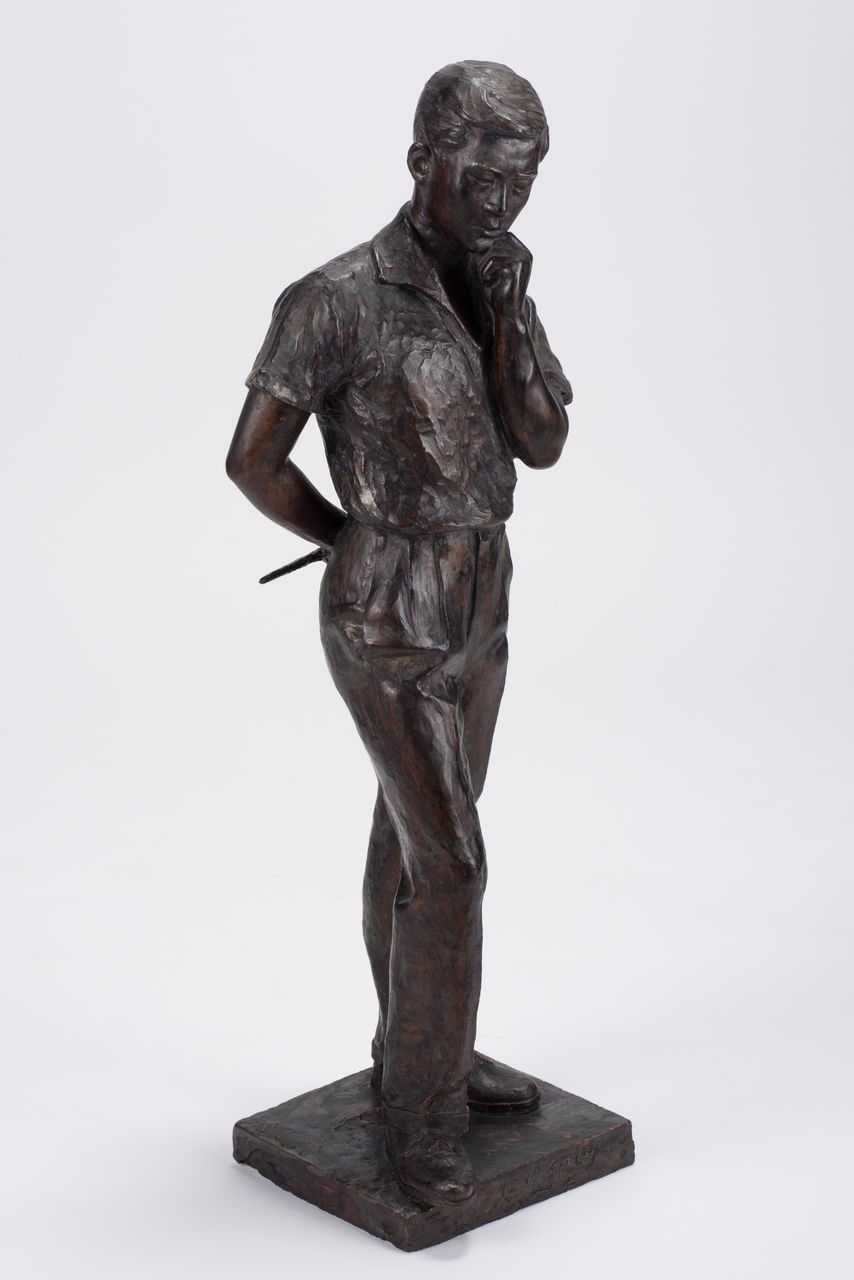
Lee Boon Wang’s Before the Moment of Painting (fig. 27) provides an entry point into how “the real” was conceived critically by realist artists.
Fig. 27. Lee Boon Wang. Before the Moment of Painting. 1959. Plaster of Paris, 81.8 × 22.5 × 23 cm.
His plaster cast of Chua Mia Tee deep in thought before painting reveals the importance placed by Realists to conceptualise and engage in both critical and creative thinking before making art. It is this moment, a pause for critical reflection; and a commitment to engage with the social conditions of their subject through research, study and criticality that forms a bridge between Realist and abstract artists seeking different modes of representation.